



For much of the past century, Patou has occupied a paradoxical place in fashion history: foundational yet dormant. Once among the most important couturiers in the 1920s and early 1930s, the house helped define a modern vision of the female wardrobe before receding into decades of diminished visibility following Jean Patou’s death in 1936. What endured was fragrance licensing, anchored by the JOY perfume launched in 1929, preserving the Patou name in consumer consciousness even as the brand itself largely vanished from commerce.
Over that period of dormancy, the U.S. trademark register came to quietly reflect the shift. Third-party owned registrations for marks like JOY CULT, JOYLAND, BODYJOY, JOYMEET, and JOY ENVIE accumulated across cosmetics, wellness, fragrance-adjacent goods, and lifestyle categories. In the absence of an active party policing unauthorized use of Patou’s JOY mark on fragrances, third parties treated “joy” as fair game, a perception reinforced as even sophisticated companies adopted JOY-based branding for beauty and fragrance goods.
Fast forward and that disconnect between Jean Patou’s legacy and the brand’s activity has come to shape Patou’s modern trademark reckoning, much of which centers on the word “JOY.”
The Legal Consequences of Dormancy
The roots of Patou’s modern enforcement strategy lie in its acquisition by LVMH. In 2018, LVMH acquired Jean Patou in what the media described as a “stealth” transaction, with the French group taking control of the brand and its intellectual property from UK-based licensee Designer Parfums. Former Dior CEO and LVMH Fashion Group chairman Sidney Toledano took on the role of chairman of Patou’s board, and Guillaume Henry, previously creative director at Carven and Nina Ricci, was appointed to relaunch women’s ready-to-wear.
By 2019, the house formally reintroduced itself simply as “Patou,” positioning the revival as both a heritage reclamation and a modern luxury reboot.
The timing was not coincidental. Just one year earlier, LVMH-owned Dior had launched a fragrance named JOY – the same name as Patou’s historic perfume – an overlap that became largely frictionless once Patou entered the LVMH portfolio. But beneath the branding narrative, a quieter and more consequential legal campaign was already underway.
Beginning in 2019, Patou dramatically increased its activity before the U.S. Trademark Trial and Appeal Board (“TTAB”), filing a steady stream of oppositions and procedural filings targeted at applications for JOY-centric trademarks.
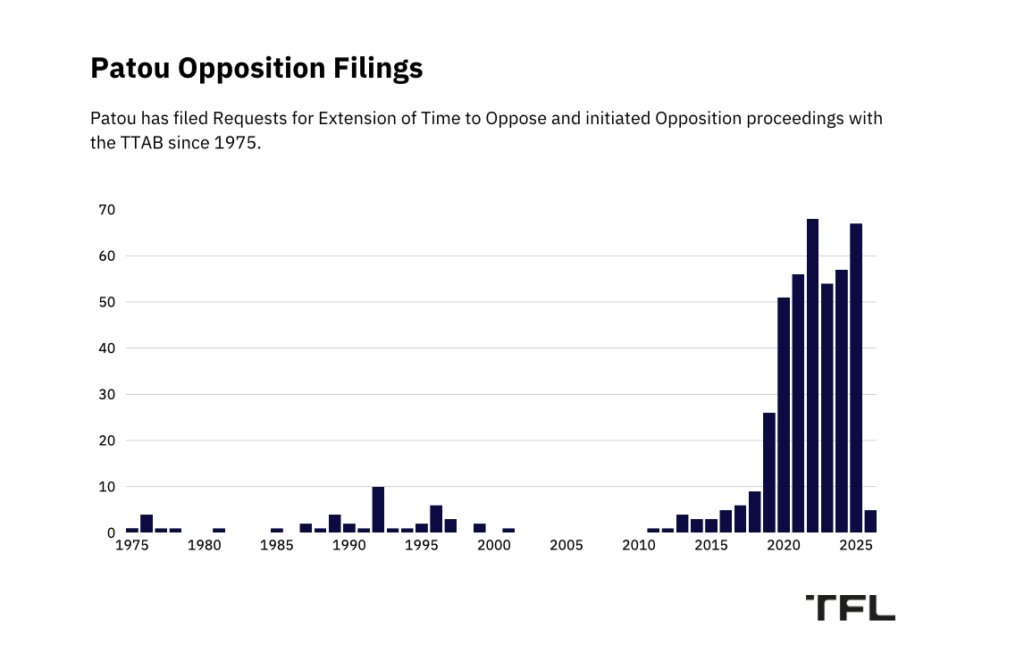
Notably, Patou does not appear to be pursuing U.S. infringement litigation in federal court. Instead, its enforcement posture is concentrated almost entirely on blocking others’ attempts to register JOY-centric marks at the USPTO – from names such as JOYROSE, JOYNOW, and JOY 101 to phrases like “A LITTLE JOY, EVERY DAY” for use on perfumes, cosmetics, and wellness products.
Importantly, not every filing in the dataset has matured into a fully-prosecuted opposition. A meaningful subset consists of Requests for Extension of Time to Oppose, procedural mechanisms that allow a rights holder to preserve its ability to assess a potentially conflicting application before deciding whether to initiate a formal challenge. Even so, the combined volume of extensions and oppositions reflects a material uptick in monitoring and early-intervention posture – consistent with a portfolio recalibration following the LVMH acquisition.
While many of the opposed applications come from foreign manufacturers or early-stage consumer startups, the docket also includes recognizable corporate actors, including CVS Pharmacy, Walmart, Amazon, Ulta Beauty, Unilever, and Philosophy, which reveals that Patou’s enforcement strategy extends to relatively low-stakes targets and commercially significant brand owners, alike.
From Legacy to Enforcement
LVMH’s acquisition has functioned as a reset moment. What the group inherited was not merely a dormant brand and an archive, but a trademark asset whose exclusivity had been structurally eroded by years of under-enforcement. But reasserting control over JOY has required more than creative direction and retail rollout. Behind the scenes, consistent legal action is angling to restore order to a trademark landscape that had grown crowded during the brand’s absence.
Against this background, the post-2019 opposition surge resembles a delayed market correction. LVMH appears to be drawing a hard boundary around a word the industry had grown accustomed to borrowing freely, signaling that JOY is not a generic mood descriptor in fragrance, but a mark with a single, identifiable source.

This framing also explains why the enforcement program is tilted toward registry control rather than courtroom litigation. The objective does not appear to be damages or injunctions against isolated sellers; it is about controlling who can register and use the word as a trademark. Each JOY-prefixed mark on the register reduces Patou’s ability to preserve exclusivity as it rebuilds the brand globally.
That strategy has already found validation both in opposition proceedings before the TTAB and in court outside the United States. In April 2024, the General Court of the European Union, for instance, upheld the EUIPO’s refusal to register a third-party’s “Joyful by Nature” mark following an opposition brought by Patou. The court reaffirmed that Patou’s JOY mark retains reputation despite periods of dormancy, recognizing that trademark reputation erodes gradually and can persist even when active commercial use is in flux. In doing so, the court effectively validated the logic behind Patou’s broader enforcement push: that JOY still functions as a source-identifying mark in fragrance and beauty.
The Real Work Behind a Brand Revival
Reviving a heritage fashion house has always been an intensive and high-risk exercise. The fashion industry is filled with failed resurrection attempts – from Halston and Charles James to Helmut Lang. But LVMH’s historical playbook – which includes Moynat, Givenchy, Dior, etc. – suggests that legal infrastructure is as important as creative revival. Before a brand can scale product, retail, and licensing, it must reclaim control over the marks that make its name economically meaningful.
Patou’s opposition-heavy strategy reflects that logic. By policing the register aggressively and early, LVMH is not merely looking to protect the name of a perfume. It is reasserting legal control over a word that had become widely used – and more than that, it is laying the groundwork for a significant luxury revival.
Share