


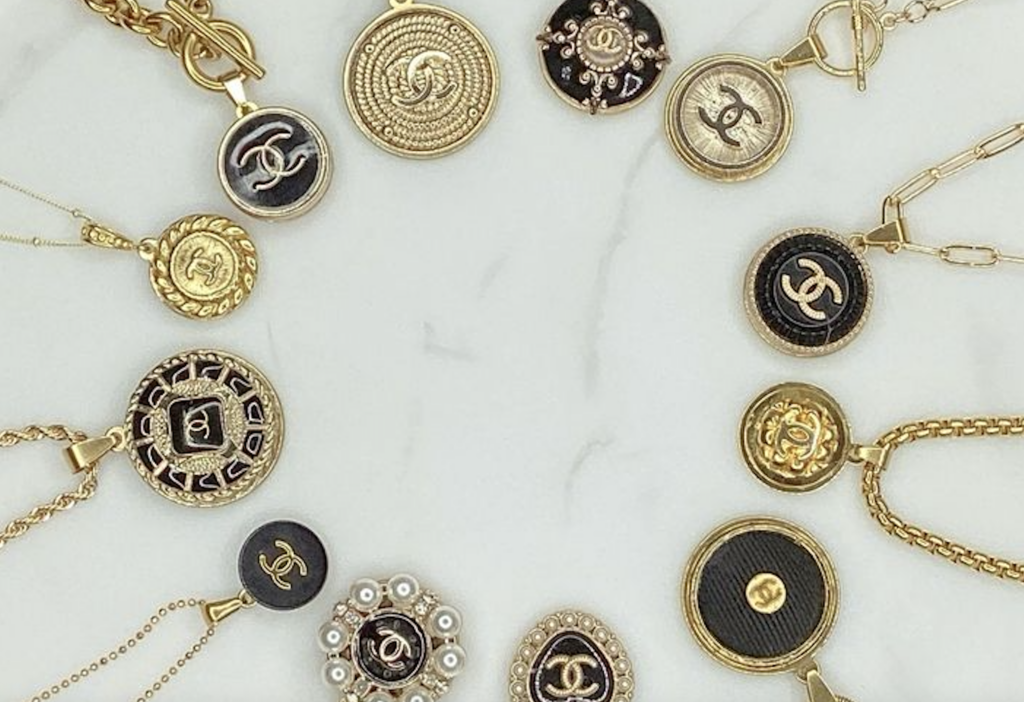
French courts have handed luxury giants back-to-back wins against upcycling designers, reinforcing a simple principle: consumers may resell branded goods, but they may not reconstruct them into new commercial products. As fashion’s waste crisis deepens, those decisions expose a growing tension between circularity and intellectual property rights.
The practice of transforming existing products and materials into new creations – commonly known as “upcycling” – has gained significant traction across the fashion industry in recent years. Patagonia repurposes retired rain jackets into compact travel cases. H&M Beyond has partnered with Revibe on a limited-edition upcycled collection. Luxury houses have also embraced the practice: Gucci’s Equilibrium program reclaims surplus production materials, Hermès repurposes remnants from past collections, and Salvatore Ferragamo gives vintage silk new life in footwear and leather goods.
Beyond brands, individual designers have fueled the movement, with Etsy listings tagged “upcycled” rising from fewer than 8,000 in 2010 to nearly 200,000 today.
Upcycling’s Legal Test
The Paris Judicial Court issued a decision with significant implications for sustainable fashion. On May 21, the court sided with Chanel in a dispute against a designer who had transformed Chanel buttons and belts into decorative jewelry and sold the pieces online as original upcycled creations. The case attracted considerable attention because it tested whether upcycling could serve as a defense to intellectual property infringement claims. The Paris court’s answer was no.
The case pitted Chanel against a designer who used Chanel buttons and buckles to create decorative jewelry and marketed the pieces with disclaimers and certificates of authenticity stating that customers were purchasing the designer’s own creations – not Chanel products. The court nevertheless found for Chanel, holding, in essence, that purchasing a product gives consumers the right to resell it – not to reconstruct it into a new commercial product.
The Chanel ruling did not arrive in a vacuum. It follows another recent French decision involving luxury brands and upcycling. In 2025, Hermès successfully sued a designer who cut patches from iconic Hermès scarves and sewed them onto vintage Levi’s denim jackets. Although the courts relied on different legal theories, both decisions reached the same practical conclusion: once an authentic branded product is transformed into something new, the first-sale principle no longer shields the seller from infringement claims.
Sustainability Meets Trademark Law
The implications extend well beyond luxury branding. According to McKinsey data, for every five garments produced globally, three are either landfilled or incinerated each year. Less than 1 percent of materials used to produce clothing are recycled into new garments, despite an estimated $500 billion in value that could be recaptured through a more circular fashion system. Meanwhile, the United Nations Environment Programme estimates that the fashion industry consumes approximately 215 trillion liters of water annually.
Against this backdrop, upcycling has emerged as one of the fashion industry’s more creative responses to textile waste. The recent Chanel ruling, however, underscores that sustainability initiatives must operate within the boundaries of intellectual property law. While the decision represents a clear victory for trademark rights, it also highlights a growing tension between trademark protection and circular business models.
To be clear: the courts were not wrong on the law. Chanel’s iconic marks are not public property simply because an authentic product changes hands. Building a jewelry business whose commercial appeal rests squarely on another house’s trademarks is opportunistic, and brands – in the luxury segment and beyond – have a legitimate interest in preventing the unauthorized dilution of their brand equity. Protecting trademark rights and brand equity serves important commercial and legal functions.
More significantly, however, the ruling leaves little room for good-faith efforts to operate transparently. In Chanel, the designer expressly told consumers that the jewelry was not made by Chanel, yet the court concluded that these disclosures strengthened – not weakened – the infringement case. If honest labeling is treated as evidence of infringement rather than a good-faith effort to avoid consumer confusion, independent upcyclers are left with no workable path forward.
The practical result is that sustainable innovation increasingly depends on obtaining permission – or licensing rights – from the very brands whose products are being transformed. That effectively reinforces a system in which large luxury houses determine the terms of circular creativity, while many independent designers are effectively excluded.
THE BIGGER PICTURE: The fashion industry has spent years publicly embracing circularity as a business imperative. These decisions do not undermine that goal, but they do expose the legal constraints surrounding one of its most visible expressions. The question is no longer whether Chanel and Hermès had the stronger legal claims; they did. The harder question is whether current intellectual property doctrine leaves sufficient room for the circular business models the fashion industry increasingly says it wants to encourage.
Kimiya Shams is an executive lawyer and advisor with extensive experience in international intellectual property law, technology and transactions. She has advised global companies, from high-growth startups to publicly traded organizations, on legal and strategic matters across the U.S., Europe and international markets.
Share