

Once defined by one-off creations in a niche industry, upcycling and product customization have evolved into one of the most disruptive forces in luxury, reshaping how consumers interact with high-end fashion, jewelry, and watches. No longer satisfied with off-the-rack exclusivity, today’s luxury buyers are seeking products that feel hyper-personalized, circular, and one-of-a-kind. This cultural pivot has given rise to an explosion of creative experimentation, where vintage designer handbags are transformed into statement jackets, Chanel buttons are reborn as bespoke jewelry, and iconic timepieces are reimagined into entirely new creations.
What was once a fringe movement championed by small-scale artisans is now a cultural and commercial shift, reflecting the growing influence of sustainability-driven consumption and the appeal of unique, story-driven luxury goods.
Friction with Luxury’s Biggest Players
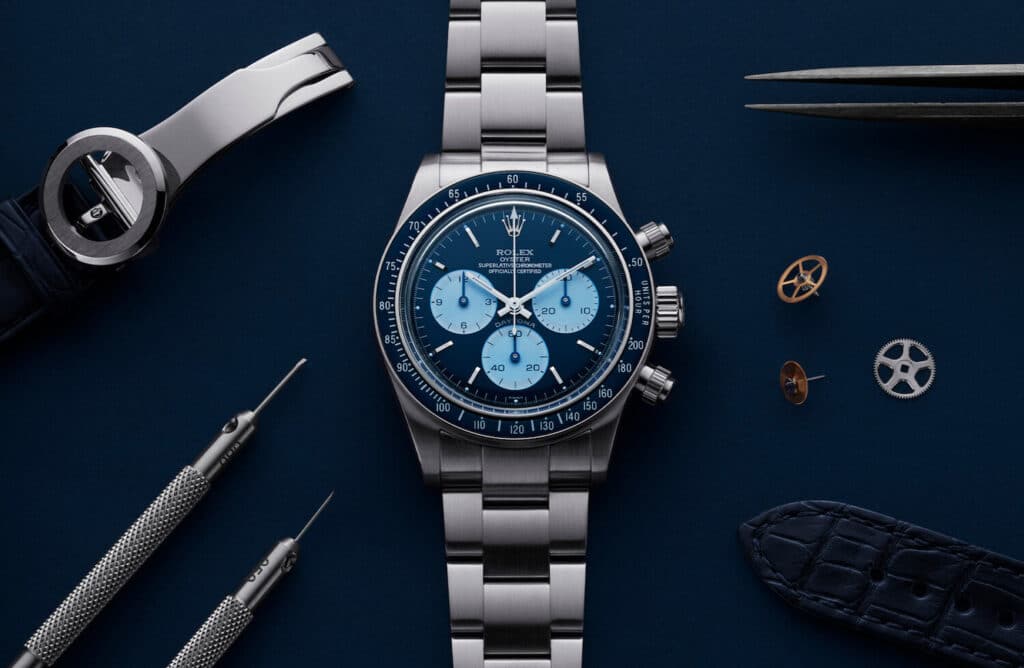
Yet, the meteoric rise of upcycling and customization is creating friction with the luxury industry’s biggest players, sparking a wave of legal battles that could define the future of “ownership” in fashion, luxury, and beyond. Rolex, for example, has taken a particularly hardline stance, filing claims against Artisans de Genève, a Swiss atelier renowned for creating one-of-a-kind, client-requested modifications of Rolex watches. In its case, Rolex argued that Artisans de Genève’s customized timepieces – including extensively reworked Daytona and Submariner models – infringe its trademarks and dilute its brand by producing watches that no longer meet Rolex’s uncompromising quality standards.
Chanel, for its part, has also made headlines after sending a cease-and-desist letter to Palm Beach-based J. Logan Home, which had transformed authentic Chanel scarves into shirts – one of which went viral after being worn by NFL star Travis Kelce. The luxury goods giant has also taken aim at companies like Shiver + Duke, which repurposed CC-button hardware into jewelry, claiming these pieces “unlawfully piggyback” on Chanel’s reputation and risk confusing consumers.
But this is not just a fashion industry phenomenon – it is a cultural showdown with significant legal and business implications.
At its core, the battle over upcycling and customization is a dispute over control: Who owns a luxury product once it has been lawfully purchased, and how far does a brand’s authority extend after that initial sale?
For decades, the first sale doctrine (or exhaustion principle) has served as a cornerstone of luxury resale and secondary markets, allowing consumers to resell, repair, and modify genuine goods without the brand’s permission. But as upcycling and customization push far beyond minor alterations – turning handbags into garments, watch movements into sculptural objects, and hardware into standalone jewelry – luxury brands are increasingly arguing that these practices cross a legal and conceptual line. In their view, such transformations do not merely involve the resale of authentic goods; they create entirely new products that trade on protected trademarks, trade dress, and brand equity.
Customizations Land in Court
This distinction is being tested in courts and enforcement actions worldwide. Brands like Rolex and Chanel are not challenging the resale of authentic goods per se. Instead, they are advancing a more aggressive theory: that extensive modification, reassembly, or repurposing strips a product of its authenticity and creates a “materially different” good that falls outside the protections of exhaustion. Once that threshold is crossed, the argument goes, the modified product becomes an unauthorized product – one that can mislead consumers, dilute brand value, and undermine the carefully curated narratives of quality, craftsmanship, and heritage that define luxury.
Customization workshops and upcyclers, meanwhile, see the matter very differently. For them, these practices represent a legitimate exercise of ownership, creativity, and consumer demand. They argue that clear disclosures, client-driven commissions, and the use of lawfully acquired goods should shield them from trademark infringement claims. Many liken their work to restoration, personalization, or even contemporary art – an evolution of luxury consumption rather than an attack on it.
The tension between these positions reveals a deeper fault line within the luxury business itself. Luxury brands have spent decades promoting individuality, craftsmanship, and self-expression, encouraging consumers to see products as extensions of identity. Yet, as consumers take that message literally – altering and reimagining luxury goods in ways brands did not authorize – the industry is responding with rigid enforcement and litigation. The result is a paradox: a market that celebrates uniqueness while legally resisting it.
There are also significant commercial stakes at play. Upcycling and customization threaten to disrupt luxury’s tightly controlled ecosystem by diverting attention – and spending – away from primary channels and authorized after-sales services. At the same time, they expose vulnerabilities in brand storytelling: if a watch or handbag can be transformed into something entirely new and still command a premium, it raises uncomfortable questions about where value truly resides – in the object, the logo, or the narrative constructed around it.
Looking Ahead
Looking ahead, the outcome of these disputes may reshape the boundaries of luxury ownership. Courts will be asked to balance trademark protection against consumer rights, artistic expression, and sustainability-driven innovation. Legislators and regulators may also be forced to weigh in as circular fashion and ESG commitments clash with increasingly aggressive enforcement strategies.
What is clear is that upcycling and customization are not a passing trend. They reflect a broader redefinition of luxury in an era marked by environmental awareness, digital virality, and a desire for authenticity that goes beyond branding. Whether luxury houses choose to continue fighting these practices through litigation or find ways to integrate them into their business models may ultimately determine not only the legal landscape, but the cultural relevance of luxury itself.
In the end, the question is no longer whether consumers will reshape luxury products – they already have. The real question is whether luxury brands can adapt to a world in which exclusivity is no longer defined solely by control, but by collaboration, transparency, and the willingness to let go.
Share