


LEGO has failed to knock out copyright claims in a lawsuit accusing it of copying artwork from a jacket worn by Queer Eye star Antoni Porowski for a LEGO set. In a newly-issued ruling, Judge Omar A. Williams of the U.S. District Court for the District of Connecticut granted in part and denied in part LEGO’s motion for summary judgment, refusing to dispose of artist James Concannon’s direct, contributory, and vicarious copyright infringement claims after rejecting LEGO’s implied-license and fair-use defenses.
The case got its start in 2021, when Concannon sued LEGO over its Queer Eye – The Fab 5 Loft set. In 2018, Porowski commissioned Concannon to design a black leather jacket for him, which he subsequently wore on Queer Eye. Concannon claims rights in the artwork on the jacket, including the use, combination, and arrangement of its elements, which he alleges LEGO copied for a similar jacket worn by the Porowski Minifigure in the set.
LEGO sought summary judgment on Concannon’s copyright claims on two grounds: that he granted Porowski an implied license broad enough to permit the challenged use and that LEGO’s use constitutes fair use.
The Jacket Behind the Case
In the September 27 ruling, as first reported by TFL, the court granted summary judgment to LEGO on Concannon’s trade dress claim, while allowing his Connecticut Unfair Trade Practices Act claim to proceed.
> Implied License: The court found that Concannon’s gift of the jacket to Porowski, knowledge that he would wear it publicly and on Queer Eye, and failure to object to its appearance on the show did not establish an implied license to copy and distribute the jacket artwork more broadly. The evidence could instead indicate a limited license to wear the jacket on the show and at public appearances.
The court distinguished this from Solid Oak Sketches v. 2K Games, which involved NBA players’ tattoos reproduced in a video game. Unlike the tattoo artists there, Concannon did not acknowledge that he intended his work to be incorporated into Porowski’s likeness. The court also distinguished tattoos permanently affixed to the body from removable clothing.
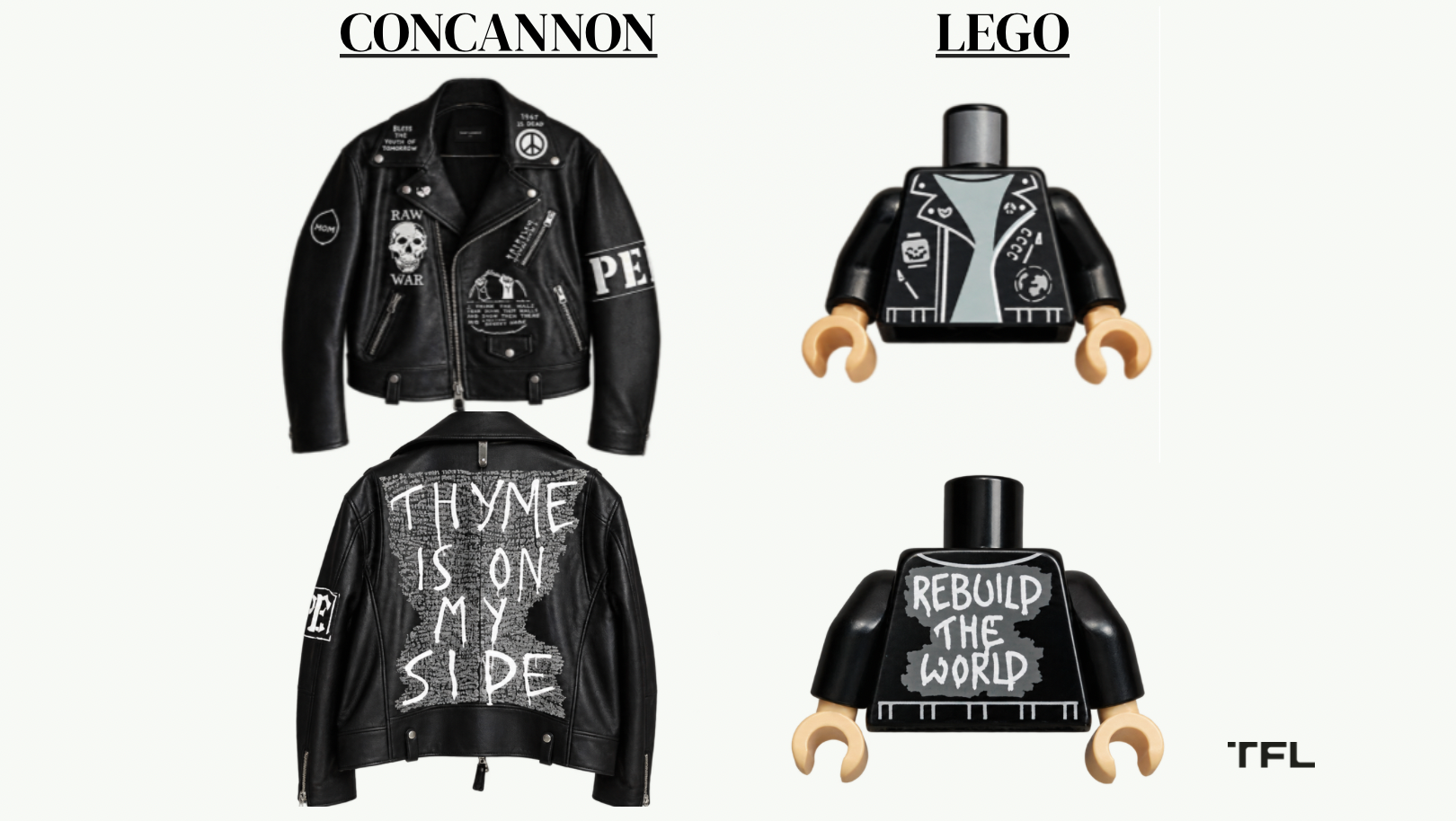
> The Fair Use Defense: The court also rejected LEGO’s fair use defense, finding that none of the four statutory factors favor the company. LEGO said its use served to accurately depict Porowski and promote the LEGO-Queer Eyecollaboration. The court found those purposes commercial and concluded that accurately reproducing the artwork did not make the use transformative.
An early version of the Minifigure jacket reproduced Concannon’s “THYME IS ON MY SIDE” wording and according to the ruling, attempted to reproduce his lettering exactly, including the paint drips. LEGO later replaced the phrase with “REBUILD THE WORLD,” but retained the font and original drips. The court found that a reasonable jury could also conclude that other graphics and their placement closely imitate Concannon’s jacket.
Citing Andy Warhol Foundation v. Goldsmith, Judge Williams found that applying what LEGO called its “LEGO DNA” to another artist’s work did not provide sufficient justification for the copying. The court also rejected LEGO’s market-harm argument, pointing to a copyright holder’s right to control derivative works.
Concannon’s trade dress claim fared differently. While the court left secondary meaning for a jury, it held that Concannon failed to raise a genuine issue of material fact as to likelihood of confusion, finding insufficient evidence that consumers would believe he produced the Minifigure jacket.
THE STRATEGY: The ruling is a reminder for companies licensing a celebrity’s likeness to separately assess third-party works that appear as part of that likeness. LEGO had licensed Porowski’s likeness but could not establish at summary judgment that Concannon granted an implied license broad enough to cover reproduction of his jacket artwork.
For counsel, that means reviewing the underlying reference material before a collaboration moves into production. If a garment or accessory incorporates third-party artwork, the question is whether the rights needed to reproduce that work are covered by the applicable licenses.
The case is Concannon v. Lego Systems Inc., 3:21-cv-01678 (D. Conn).t
Share