

A behind-the-scenes trademark clash is pitting Nike against Shein, with the sportswear titan taking on the ultra-fast fashion giant over rights in the CORTEZ name. In a newly filed opposition, Nike is asking the U.S. Trademark Trial and Appeal Board (“TTAB”) to reject an application lodged by Roadget Business Pte. Ltd., the parent company of global fast-fashion e-commerce company SHEIN, which is looking to register a mark consisting of a stylized version of the word COUREZ for use on apparel and footwear.
In January 2025, Roadget filed an intent-to-use application in the U.S. for the COUREZ mark for a range of apparel and footwear, including shirts, dresses, hoodies, jeans, footwear, shoes, boots, and headwear, prompting Nike to formally challenge the registration. The basis for Nike’s opposition: a likelihood of confusion with its longstanding CORTEZ mark.
Defining & Defending CORTEZ
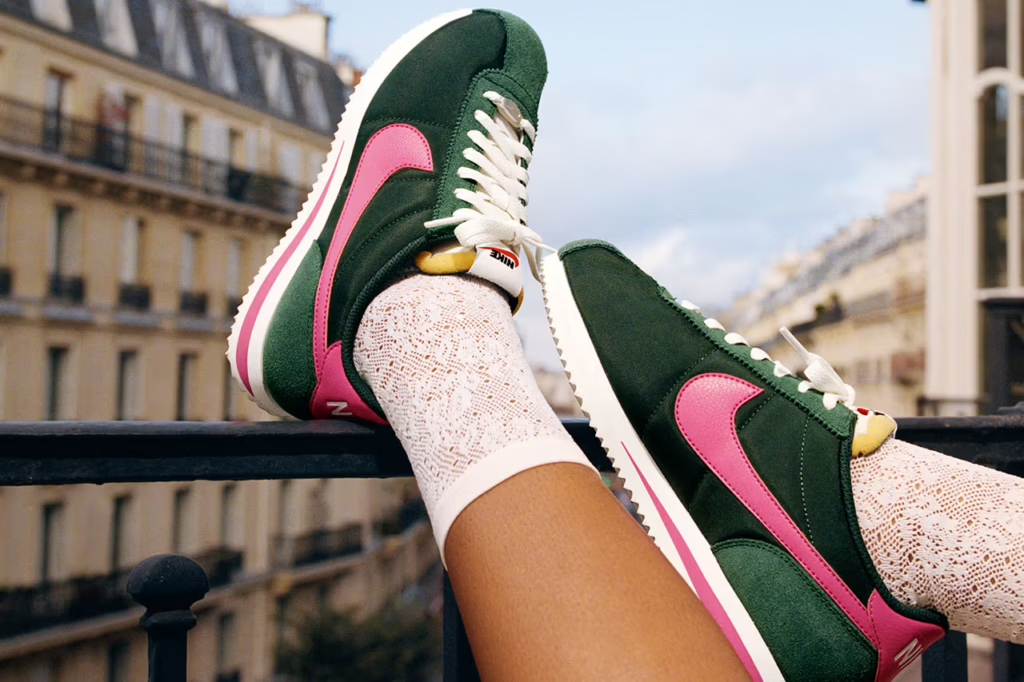
Setting the stage in its February 23 Notice of Opposition, Nike emphasizes its enduring use of the CORTEZ name, which it says dates back to at least 1968. The Cortez running sneaker made its official debut at the 1972 Munich Olympic Games and has since evolved into one of Nike’s most recognizable and enduring silhouettes, straddling performance athletics and lifestyle wear, counsel for the Swoosh argues.
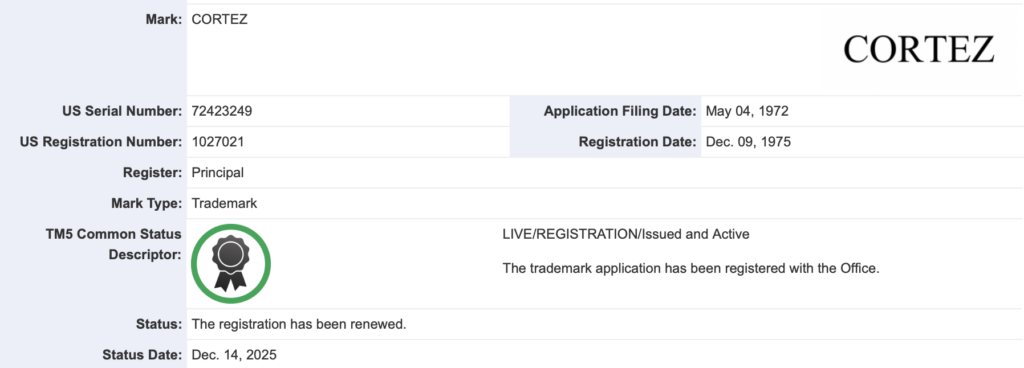
In addition to the common law rights it has amassed in the Cortez name, Nike points to its incontestable federal trademark registration for CORTEZ for “athletic shoes for track and field,” issued in 1975, which it says serves as conclusive evidence of the validity of the mark and Nike’s exclusive right to use it in connection with the goods at issue.
Nike argues that Roadget’s applied-for mark is “virtually identical” in appearance and commercial impression to CORTEZ, and given the overlap in goods, particularly footwear, Nike contends that consumers are likely to mistakenly believe that any SHEIN products bearing the mark originate with, are sponsored by, or are otherwise affiliated with Nike. Beyond that, Nike argues that the goods identified in Roadget’s application are not only similar to Nike’s but are goods that “may be offered in the same channels of trade to the same types of consumers for Nike’s goods,” thereby increasing the potential for consumer confusion.
More Than a Routine Opposition?
While oppositions are a routine facet of trademark enforcement in the consumer goods segment, there is context here adds a layer of potential significance. After all, SHEIN has repeatedly sought federal trademark protections for proprietary in-house brands, building out a portfolio of sub-labels that function as semi-distinct verticals within its broader platform. Interestingly, most of those marks rely on newly coined terms or deliberately stylized spellings – from AKNOTIC (for use on men’s clothing), PREPCRW (children’s wear), and CUCCOO (shoes) to DREAMSKYNE, DENIMOI, ATHIRAL, and CASUGLOW (womenswear).
The strategy is notable: invented or stylized names are inherently distinctive, easier to clear from a trademark registration perspective, and less likely to trigger (but as indicated here, not entirely insulated from) objections from incumbent brand owners. At the same time, they allow SHEIN to cultivate micro-brand identities that can be scaled independently within its existing model.
The COUREZ mark appears to fit squarely within this playbook. Roadget riled its application on an intent-to-use basis, but the name – along with the stylized iteration at play – is already being used across SHEIN’s platform on jeans, sweatshirts, skirts, and other ready-to-wear items – though, notably, not sneakers. Rather than a single product designation, the use suggests the development of a standalone label embedded directly into SHEIN’s retail infrastructure.
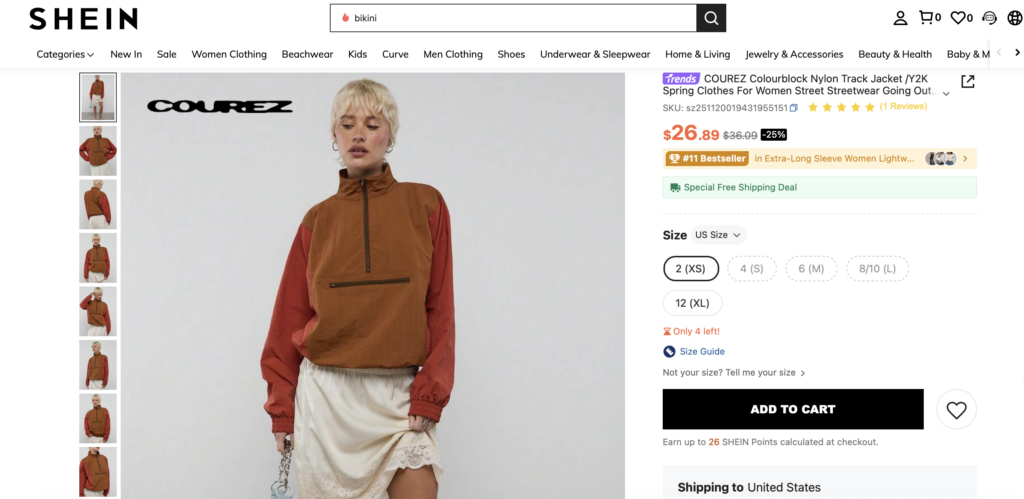
At the same time, the absence of sneakers from SHEIN’s current COUREZ offerings is worthy of attention, as it could complicate the confusion analysis. Much of the SHEIN apparel bearing the COUREZ name appears to consist of trend-driven fashion pieces rather than sneakers – the category most closely associated with the CORTEZ legacy. Whether consumers would readily assume a connection between Nike’s heritage running silhouette and SHEIN’s trend-driven ready-to-wear is not necessarily self-evident.
Still, the overlap is not immaterial. The COUREZ name appears on sweatshirts, track jackets, and other athleisure-adjacent pieces on SHEIN’s site – categories that fall within Nike’s broader apparel business, even if the CORTEZ name is most closely associated with footwear (save for some examples of it appearing on Nike clothing). In that context, the absence of COUREZ-branded sneakers may not be dispositive, particularly where the marks and the general class of goods are alleged to be highly similar.
Against that backdrop, the implications for Nike extend beyond a textbook confusion analysis. SHEIN’s model – anchored in real-time demand signals, vertically integrated production, and algorithm-driven merchandising – allows new labels to achieve rapid, high-volume visibility across categories and geographies. In a high-volume, algorithmically amplified retail ecosystem, even incremental consumer association can compound quickly. For Nike, the concern is not simply a similar name appearing on a handful of garments, but the prospect of a CORTEZ-adjacent label becoming deeply integrated into a global fast-fashion platform.
THE BOTTOM LINE: The dispute shows how established brands continue to police legacy product names – particularly in a market where fast-fashion players can scale new labels and lookalike goods globally in a matter of weeks. For Nike, the TTAB fight is less about a single application and more about maintaining control over a sneaker name that has anchored its brand for more than half a century.
Share