



The widespread adoption of artificial intelligence is changing what retailers have to account for in their legal terms. AI has long powered product recommendations, personalization, search, customer service, and other retail functions. But the rise of generative AI and agentic commerce is introducing a different set of interactions, as AI systems navigate retail websites and access content, use data to train models, and begin to act on consumers’ behalf in the shopping process.
In an evolving tech and legal landscape, retail companies are starting to set rules around those interactions. Some restrict scraping or the use of their content and data for AI training. Others address third-party AI agents accessing their platforms or acting on customers’ behalf. And companies offering their own consumer-facing AI tools are establishing terms around inputs, outputs, data, liability, and acceptable use.
To see how companies are addressing these new AI-related interactions, TFL exclusively reviewed customer-facing terms, privacy policies, AI policies, and related legal notices from 35 leading companies across fashion, luxury, beauty, technology, automotive, and other sectors. The resulting Retail AI Terms Tracker shows a wide range of approaches. Some companies have developed detailed provisions governing AI interactions, while TFL identified no express reference to AI in the customer-facing documents reviewed for others.
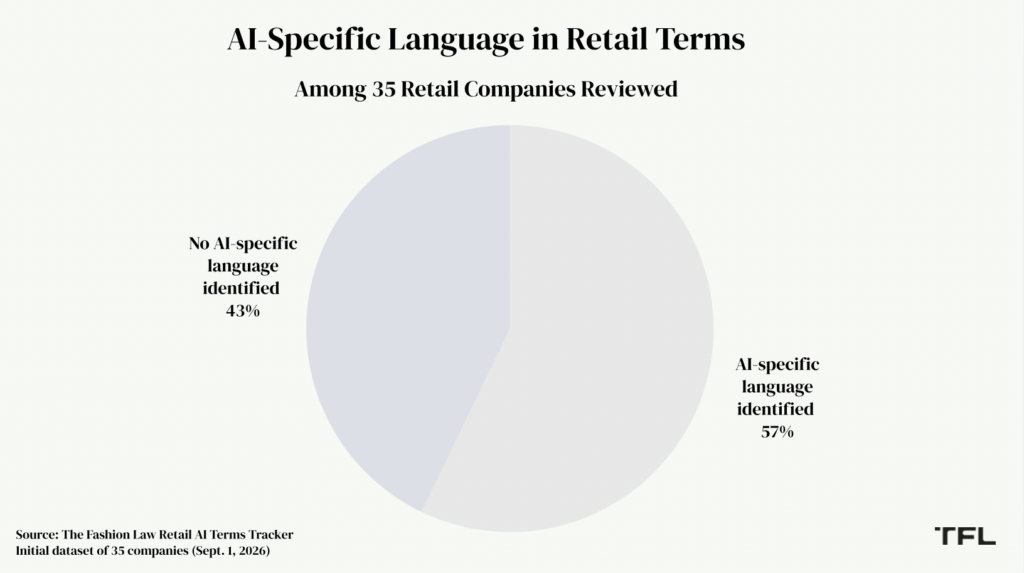
Several patterns emerge from the initial dataset.
How are retailers writing the rules for AI?
There is no standard approach to addressing AI in consumer-facing legal terms. Some companies make narrow references to the technology, such as restricting automated access to their websites or the use of their content to train AI systems. Others have established more extensive frameworks governing AI-powered tools, including what consumers can submit, how outputs may be used, what data may be collected, and the limits of companies’ responsibility for AI-generated information.
The differences are visible in both the substance and placement of these provisions. Zara, for example, maintains a dedicated legal notice for its AI Assistant, while L’Oréal addresses AI through provisions covering prompts, outputs, prohibited uses, consumer reliance, and other issues.
Whether the particular provisions that companies have adopted will ultimately be enforceable, and against whom, is a separate question. Courts have long addressed the enforceability of online terms, including questions of notice and assent, but many of the AI-specific restrictions and applications now appearing in retail terms have yet to be extensively tested. Their enforceability may turn on established principles of contract law, as well as the language, presentation, scope, and application of the particular provision.
A number of the companies reviewed do not expressly address AI in the customer-facing documents included in the tracker. That does not mean those companies are not using AI or addressing it elsewhere. It means that TFL did not identify AI-specific language in the particular documents reviewed.
Who gets to use retail content and data to train AI?
One of the clearest patterns in TFL’s dataset concerns AI training. Nike, Cartier, Sephora, TJ Maxx, Williams-Sonoma, L’Oréal, Coach, and others restrict certain uses of their websites, content, or data in connection with the development, training, or improvement of AI or machine-learning systems.
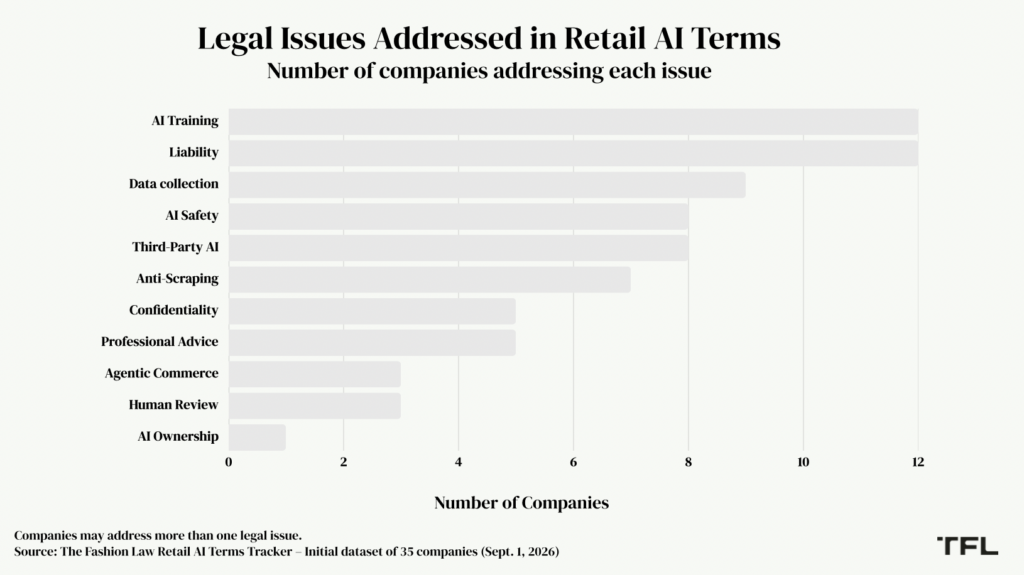
The provisions vary. Some companies expressly prohibit using specified content or materials to train or improve AI models. Others combine AI-related restrictions with prohibitions on scraping, crawling, data mining, or other forms of automated access.
The terms add a contractual dimension to disputes over access to online content and the material used to develop AI systems. In addition to relying on intellectual property and other legal rights, some companies are using their terms to specify how users may access and use their sites, content, and data for AI-related purposes.
What happens when AI becomes the shopper?
Much of the consumer-facing AI reflected in the tracker helps people search for products, get product information, receive recommendations, or interact with conversational AI tools. A smaller group of terms addresses AI systems that can act on consumers’ behalf.
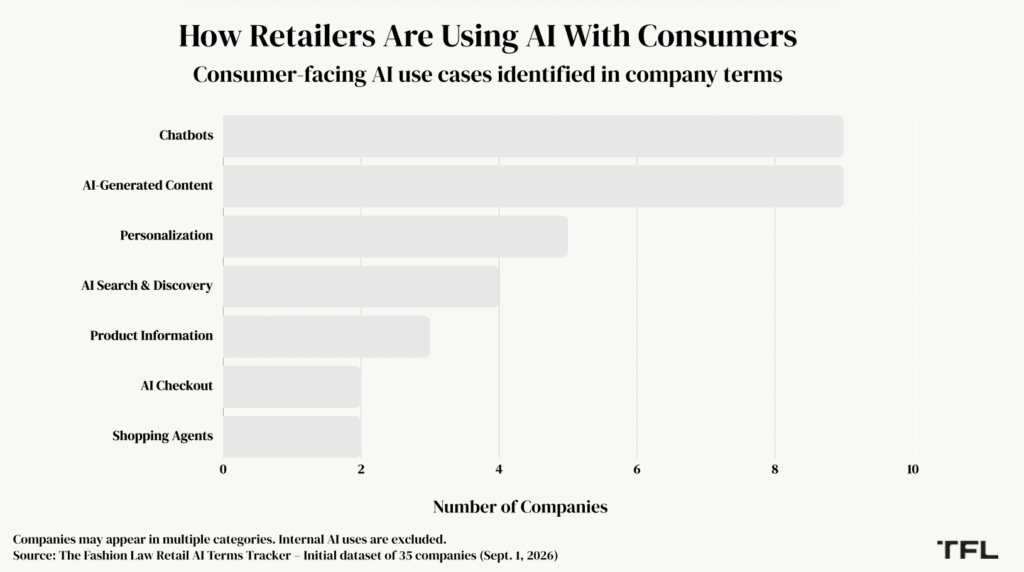
Target’s terms contemplate approved AI agents accessing customer accounts and, within authorized limits, modifying carts, placing orders, and initiating returns. Moda Operandi expressly addresses orders and services initiated through AI agents and automated shopping tools.
A chatbot recommending a dress presents different contractual questions from an AI agent authorized to buy it. Agentic commerce raises questions about the relationship among the consumer, retailer, and AI provider, including the scope of an agent’s authority and responsibility for actions taken on a customer’s behalf. For at least some retailers, those issues are already appearing in consumer-facing terms.
Who bears the risk when retail AI gets it wrong?
Companies that provide consumer-facing AI tools are also setting expectations about their limitations. Best Buy, Wayfair, Coach, Zara, L’Oréal, and others address the possibility that AI-generated information may be inaccurate, incomplete, or unreliable. Depending on the company and tool, consumers may be told to verify information, exercise their own judgment, or avoid relying on AI-generated responses for certain forms of professional advice.
Retailers may use AI to summarize product information, answer questions, make recommendations, or otherwise assist shoppers while disclaiming or limiting responsibility for the accuracy or reliability of the resulting information. The terms also differ on human involvement. Zara provides a mechanism for users to request human assistance in connection with its AI Assistant, while L’Oréal discloses that interactions with certain AI tools are not monitored by humans.
What happens to consumer data inside an AI interaction?
AI-powered retail tools can bring additional types of information into interactions between consumers and retailers. Depending on the tool, consumers may provide prompts, conversations, images, preferences, or other information. Retailers may also use browsing activity, purchase history, and other data to personalize or generate results.
The terms reviewed by TFL address different parts of that information flow. Some describe information that an AI feature may process. Others warn users against submitting confidential or sensitive information, disclose the involvement of third-party AI providers, or address the use of information in connection with the development or improvement of AI systems.
A single AI interaction can therefore implicate data collection, confidentiality, AI training, third-party services, consumer protection, and liability.
There is no single retail AI rulebook
The initial 35 companies in TFL’s proprietary dataset do not point to a uniform model for addressing the use of AI in retail. Their terms tend to reflect the ways in which AI intersects with their businesses and digital services. Nike restricts certain uses of its content in connection with AI training. L’Oréal sets rules around prompts, outputs, prohibited uses, and consumer reliance. Zara addresses the operation and limitations of an AI shopping assistant. Target and Moda Operandi contemplate AI agents acting on customers’ behalf. Tesla addresses data generated in connection with AI systems.
For now, retail AI terms remain a mix of restrictions on third-party AI use and rules governing companies’ own AI tools and services. As those uses change, the contractual and policy frameworks around them are likely to change as well.
The Fashion Law’s Retail AI Terms Tracker will be reviewed quarterly to capture additional companies and address material changes to existing terms.
Share