

This spring, Aritzia applied to register the trademark ARITZIA DUPE for use on various types of bags – seemingly inspired by a similar application lodged by Lululemon. The U.S. Patent and Trademark Office (“USPTO”), however, is not convinced. In an Office Action issued in August, the USPTO alerted Aritzia that in order for the mark to be registered, it would need to disclaim the term “DUPE” – meaning the company could not claim exclusive rights to it. The reason? The word “dupe” merely describes the goods covered by the application.
In a newly filed response, as exclusively reported by TFL, Aritzia pushes back, arguing that DUPE is far from a generic descriptor for products “designed to resemble more expensive products.” The Canadian fashion brand maintains that the term is suggestive, ambiguous, and even incongruous when used in the mark ARITZIA DUPE – and that forcing a disclaimer would weaken its ability to protect itself from the sale of infringing and/or counterfeit items.
The Deal With the Word “DUPE”
Aritzia’s central argument rests on a familiar distinction in trademark law: the line between descriptive and suggestive marks. A term is descriptive if it “immediately conveys an idea of the qualities or characteristics of the goods.” A term is suggestive if it requires, as the Trademark Trial and Appeal Board once put it, a “mental leap.”
The brand contends that consumers encountering ARITZIA DUPE would need to pause and interpret what “DUPE” means in context. Does it refer to duplicates of Aritzia’s own products? Aritzia’s cheaper line? Or a tongue-in-cheek nod to the internet’s obsession with “dupes”? Each interpretation, the filing argues, demands imagination rather than instant understanding – the hallmark of a suggestive mark.
In its response, Aritzia also relies on the incongruity doctrine, which holds that a mark may be distinctive when its elements form a phrase that is illogical or unexpected. According to Aritzia, that is precisely what is happening here, as ARITZIA DUPE combines two concepts that clash. The idea that a brand would sell “dupes” of its own products “would likely be considered nonsensical to consumers upon first glance.” Even if consumers interpret it as a line of more affordable goods, the phrase still functions as a playful, self-referential twist – a creative expression rather than a literal description.
This internal contradiction, Aritzia argues, makes the mark “unitary” and not subject to dissection or disclaimer.
Prior Trademark Treatment & Policy
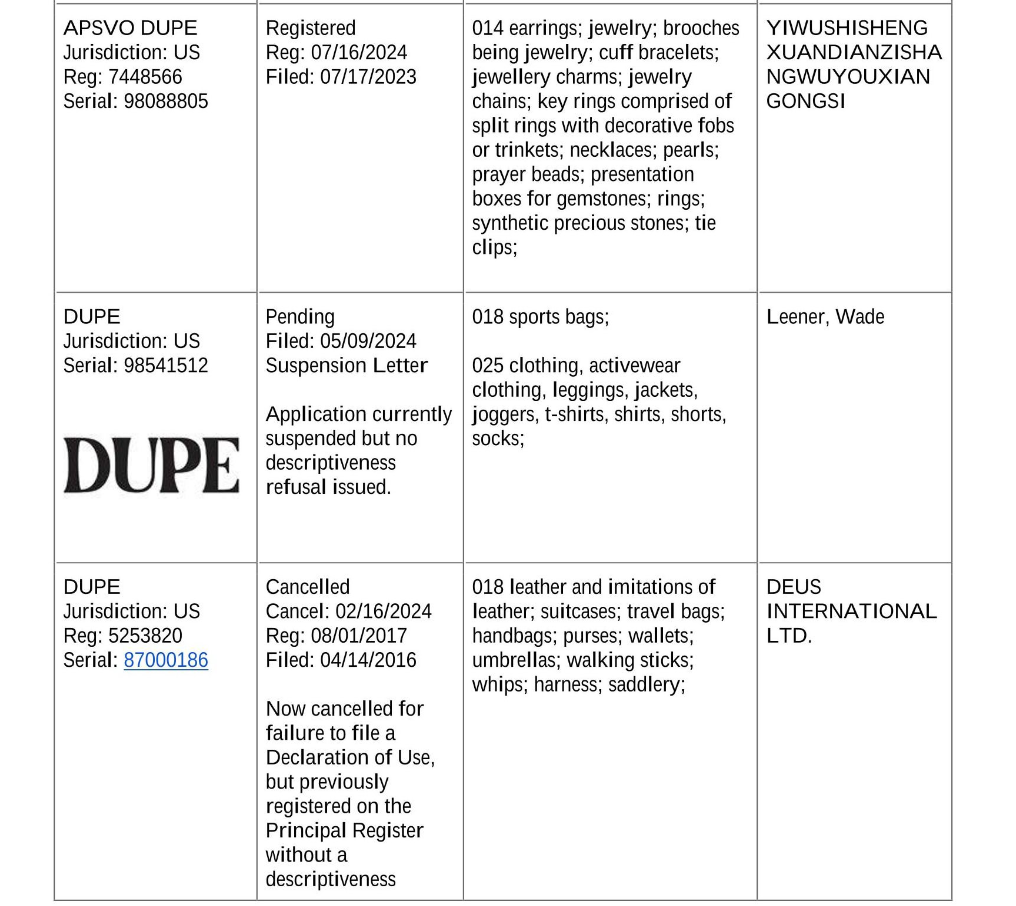
Aritzia bolsters its argument with precedent from the USPTO’s own register. The company points to numerous third-party registrations for marks containing the word “DUPE” – for use on goods/services like apparel, accessories, and retail services – registered without disclaimers or claims of acquired distinctiveness.
As the USPTO’s Trademark Trial and Appeal Board previously held, third-party registrations can serve as “dictionary evidence” of how the USPTO treats certain terms, per Aritzia. Here, Aritzia argues, that evidence shows that “DUPE” is not consistently treated as descriptive – and that denying registration here would contradict the Office’s prior practice.
Looking beyond TTAB precedent, Aritzia also grounds its argument in public policy, including the USPTO’s 2022–2026 Strategic Plan, which speaks to the agency’s goal of protecting intellectual property “against new and persistent threats.” Registering ARITZIA DUPE without a disclaimer would help it combat counterfeit and misleading “dupe” listings that flood e-commerce platforms, Aritzia argues.
Still yet, the company claims that allowing registration of ARITZIA DUPE without a disclaimer aligns with trademark law’s purpose of promoting competition and protecting product quality, as recognized by the U.S. Supreme Court, by giving the brand stronger tools to combat counterfeits and low-quality imitations online.
Can a “DUPE” Ever Function as a Trademark?
Looking beyond the specifics of Aritzia’s response, the matter raises a bigger question about the viability of ARITZIA DUPE as a mark at all. The essential function of a trademark is to distinguish one source of goods/services from another – and to signal genuine commercial origin. Would a brand like Aritzia ever use really ARITZIA DUPE to serve that function? While it is not necessarily out of the questions, it is difficult to see how. (Also, language from the response about how registration of the mark will enable Aritzia to better engage in enforcement – as opposed to using the mark to indicate the source of its own products – raises some questions on this front.)
Assuming that the USPTO agrees to register ARITZIA DUPE for use on “Purses; Carry-all bags; Leather and imitation leather bags; Wallets; Shoulder bags; Tote bags; Athletic bags,” it is worth considering whether the registration would later be vulnerable to attack on the grounds that the mark was never actually used to identify source of Aritzia goods/services in the marketplace? And if the mark’s true purpose is to stop others from marketing copycat Aritzia products (aka Aritzia dupes), there is a world in which an as-of-now-hypothetical defendant might raise a descriptiveness defense, arguing that “dupe” is a necessary term to describe imitation goods. This assumes, of course, that the defendant would likely want to publicly admit that it was selling dupes.
In that sense, the filing’s strategy may be less about building a commercial sub-brand and more about leveraging the registration to deter imitation.
A trademark registration for ARITZIA protects the company’s genuine business. But does ARITZIA DUPE serve the same legitimate source-identifying purpose? The answer may define how far “brand protection” can stretch into the realm of online discourse.
What Happens Next
Aritzia’s Canadian counterpart application remains pending, and the company has requested that the U.S. application be suspended until the Canadian registration issues. Whether the USPTO accepts Aritzia’s arguments could set an interesting precedent. As “dupe” culture continues to dominate social media – shorthand for imitation, affordability, and aspirational consumption – the matter raises a larger question: Can a brand own the irony of the “dupe”?
Share