

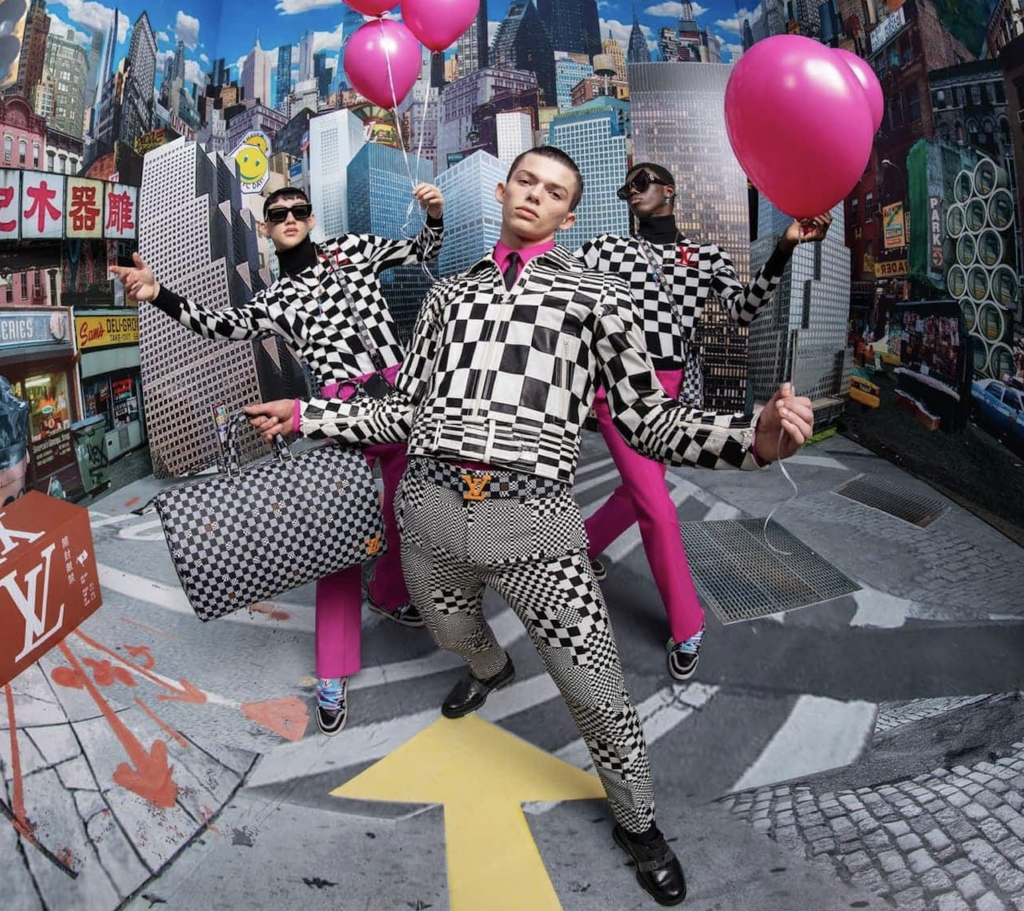
Louis Vuitton and Off-White are asking a federal court to rule in their favor in a copyright dispute over distorted checkerboard designs. In a newly filed motion for summary judgment, Louis Vuitton and Off-White Operating S.r.l. argue that the sole remaining claim brought by Philadelphia-area designer Paula Hian and her company fails because the accused designs were independently created and do not infringe Hian’s registered Plaque D’egout fabric design.
In their July 31 motion, Louis Vuitton and Off-White (the “defendants”) contend that Hian and Paula Hian Creations, Ltd. cannot establish actual copying or actionable appropriation via Louis Vuitton’s Distorted Damier prints and Off-White’s Checkerboard designs. They argue that Hian cannot establish copying, substantial similarity, or access, and that the record independently establishes how the accused designs were created.
The motion comes nearly four years after Hian sued Louis Vuitton and Off-White, then owned by LVMH, accusing them of copying her black-and-white Plaque D’egout design for apparel, accessories, and Louis Vuitton building wraps. In a June 2024 ruling, the federal court in Pennsylvania dismissed claims concerning two other Hian designs, leaving only the Plaque D’egout copyright claim.
A Three-Pronged Defense
In their motion for summary judgment on the remaining copyright claim, as first reported by TFL, LV and Off-White advance three principal arguments …
> A longstanding visual tradition: LV and Off-White devote a significant portion of their motion to tracing the history of distorted checkerboard imagery, arguing that the similarities identified by Hian reflect a longstanding visual tradition rather than expression unique to her design. They point to Renaissance artwork, Op Art, collections by brands including Nina Ricci, Pucci, Michael Kors, and Dior, and thousands of stock images featuring similar motifs.
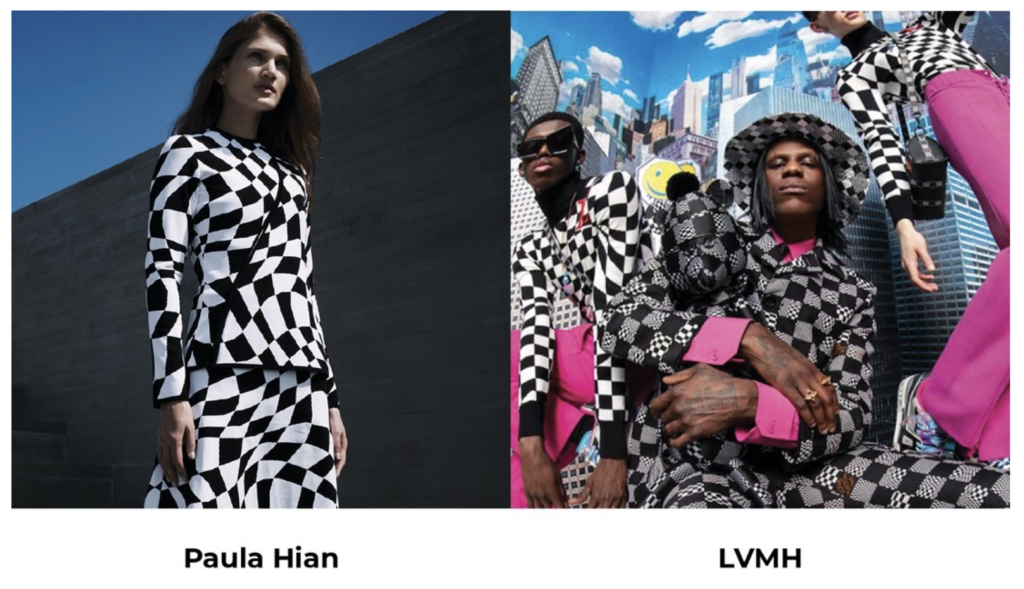
Against that backdrop, they argue the allegedly shared features are recurring elements of distorted checkerboard designs, not evidence of copying.
Louis Vuitton also points to its trademark-protected Damier checkerboard pattern, introduced in 1888, and decades of subsequent checkerboard motifs as evidence that the accused designs fit within its own design history.
> Documenting independent creation: The motion also points to contemporaneous design records – including research materials, sketches, mood boards, and internal communications that document former Louis Vuitton menswear and Off-White creative director Virgil Abloh’s development of the S/S 2021 collection from a ska-inspired concept using existing references – as evidence of independent creation (as opposed to copying).
> Contesting access: LV and Off-White also argue that Hian cannot establish that they had access to the Plaque D’egout design. They contend that there is no evidence that emails sent to an LVMH executive ever reached the designers responsible for the accused works, that there is no evidence they “shared” manufacturers with Hian, and that the design was not sufficiently disseminated to support an inference of access. The brands argue that while Hian estimates fewer than 3,000 garments bearing the Plaque D’egout design were manufactured, discovery records show fewer than 40 sales of garments bearing the Plaque D’egout design between 2016 and 2023.
THE BIGGER PICTURE: Luxury brands have long used their archives – and their heritage – as the basis for marketing, product development, and brand-building efforts. LV and Off-White’s motion suggests those archives can serve another purpose: evidence.
Rather than relying solely on side-by-side comparisons of the parties’ designs, LV, in particular, attempts to trace the accused works back through its own creative history, pointing to its more-than-100-year-old Damier checkerboard pattern, decades of subsequent checkerboard motifs, and Abloh’s earlier work. In doing so, the company’s archives are used as part of its legal defense to support its argument that the accused designs emerged from an established creative lineage rather than from Hian’s Plaque D’egout design.
The filing also illustrates how historical archives and contemporaneous design records can be deployed together in defending against copyright claims. Alongside its historical archive, Louis Vuitton relies on sketches, mood boards, internal communications, and documented source material to reconstruct the creative process behind the collection. Together, those materials illustrate how heritage and creative provenance can become as important in defending against infringement claims as the finished products themselves.
The case is Paula Hian v. Louis Vuitton USA, Inc., et al., 2:22-cv-03742 (E.D. Pa.)
Share