


Coach and Quince have brought their dupes-centric dispute to a close. In a joint stipulation filed on June 23 in the U.S. District Court for the Northern District of California, Tapestry, Coach, and Quince agreed to dismiss all claims in Coach’s lawsuit accusing the direct-to-consumer brand of selling handbags that were “substantially indistinguishable” from its Rogue and Soho Flap bags. The stipulation provides for dismissal of all claims without prejudice, with each side bearing its own attorneys’ fees, costs, and expenses.
The dismissal brings to a close a case that reflected a broader push by brands to use trade dress and unfair competition claims to challenge lower-priced lookalike products in the expanding dupe market.
When Coach and parent company Tapestry filed suit in April 2025, they alleged that Quince had crossed the line from taking inspiration to unlawfully copying the trade dress of two of Coach’s “iconic” bags. Specifically, they claimed that Quince’s “Italian Leather Medium Convertible Satchel” and “Italian Leather Buckle Detail Shoulder Bag” were confusingly similar to the trade dress of Coach’s Rogue and Soho Flap bags, respectively, by reproducing combinations of allegedly distinctive, non-functional design features associated with those handbags.
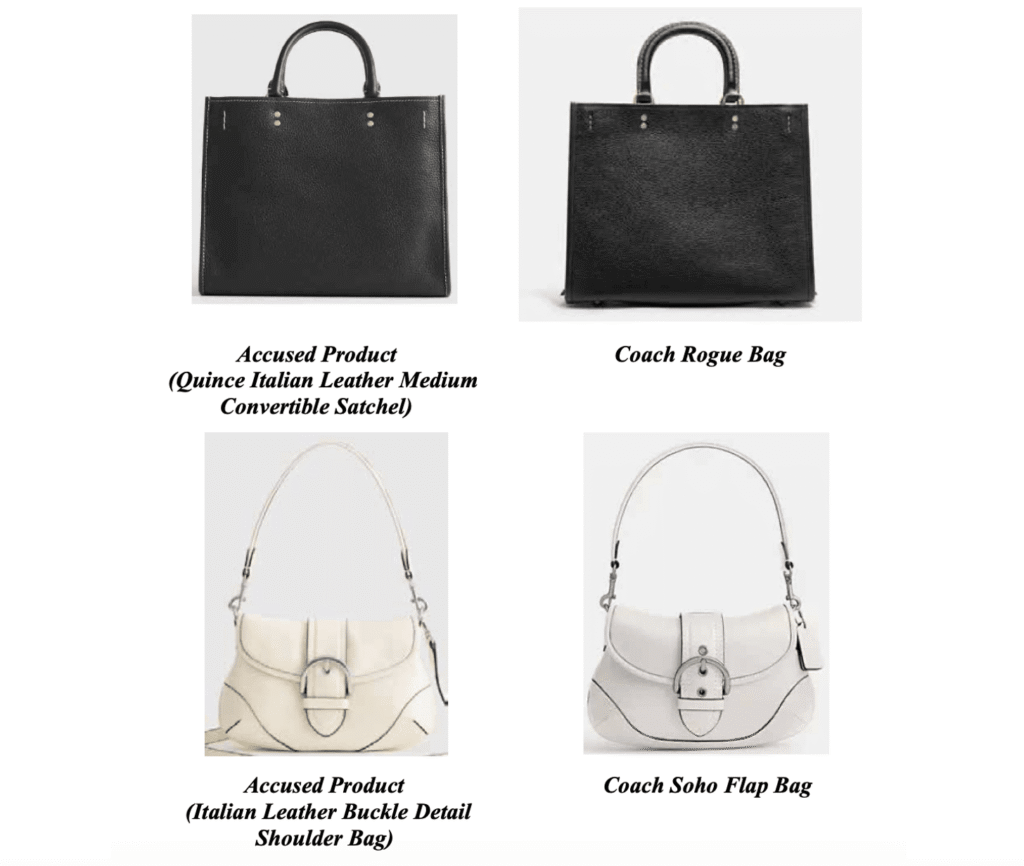
According to the complaint, Quince’s handbags were “substantially indistinguishable” from the Rogue and Soho Flap trade dress and likely to cause confusion as to source, sponsorship, or approval. Coach and Tapestry further alleged that Quince was seeking to capitalize on the recognition and goodwill associated with those bags by offering lower-priced lookalike products.
> The short-lived case was notable in part because it did not center on the alleged misuse of a logo, monogram, or brand name. Instead, Coach’s claims focused on product design itself as a source-identifying asset. In that sense, the lawsuit was part of a broader push by brands to use trade dress and related unfair competition claims against dupes, even as those claims have proven difficult to sustain in cases involving trend-driven or widely shared product designs.
Coach’s suit against Quince ends without a ruling on the merits of its trade dress claims, but it nonetheless adds to the growing body of anti-dupe litigation in which brands are invoking trademark and unfair competition law against lookalike products that do not make use of a plaintiff’s name or logo. Even without a judicial opinion, the dispute is another sign that trade dress remains part of the broader anti-dupe playbook for brands seeking to challenge lookalike products in the affordable-luxury market — even if it has proven to be an imperfect tool in practice.
The case is Tapestry Inc. et al. v. Last Brand Inc. dba Quince, 3:25-cv-03082 (N.D. Cal.).
Share