



Richemont is taking on a New York-based jeweler for allegedly co-opting the designs of some of its most successful and recognizable jewelry collections. In a complaint filed on July 30 in the Southern District of New York, as first reported by TFL, the Swiss luxury group claims that Malidani Jewelry Corp. is offering high-priced jewelry so closely resembling Cartier and Van Cleef & Arpels pieces – and at such similar price points – that the products are not just infringing, they are directly competing with the originals.
According to the complaint, Malidani is selling unauthorized versions of Cartier’s LOVE bracelet and Juste un Clou collection, as well as Van Cleef & Arpels’ trademark and design patent-protected Alhambra line. Richemont contends that the Malidani is actively attempting to deceive consumers into believing they are purchasing products of comparable origin, quality, and prestige. In doing so, Richemont argues that Malidani is unjustly enriching itself at Cartier and Van Cleef & Arpels’ expense and “unlawfully wrest[ing] from [them] control over their reputation.”
Not Just Imitation – But Market Competition
Far from a conventional counterfeit operation, Richemont claims Malidani’s jewelry is being sold at high-end prices. Bracelets mimicking the LOVE design were offered for $2,800, Juste un Clou imitations for $3,900, and Alhambra-style pieces for $3,900 to $6,000 – with the full range spanning $1,500 to $9,000, per Richemont. These prices, the luxury group argues, position the allegedly infringing goods in direct competition with the authentic products, particularly when Malidani markets the items as being “[in]distinguish[able]” from the real thing.
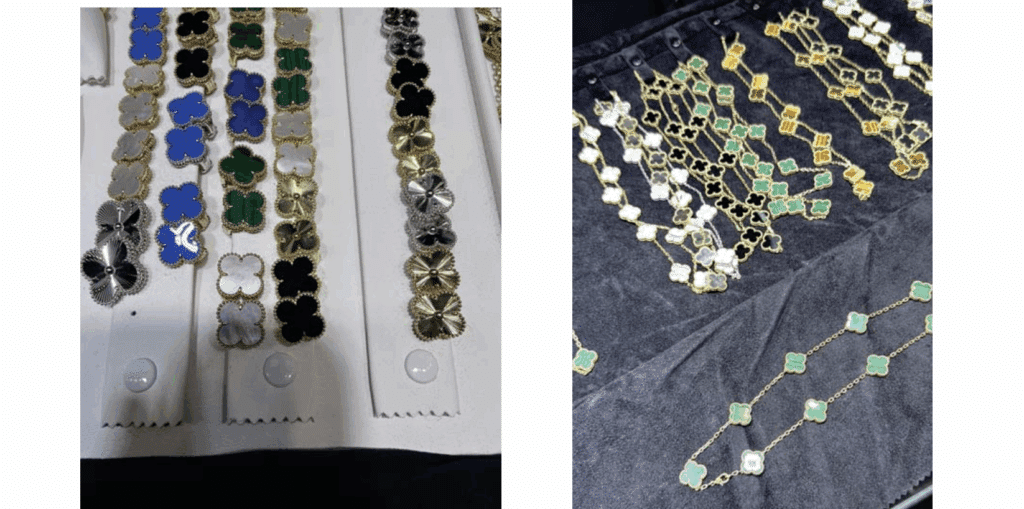
Richemont’s harm theory extends well beyond design appropriation. By offering counterfeit products at near-authentic prices, Malidani is allegedly eroding the exclusivity, prestige, and quality reputation that Cartier and Van Cleef & Arpels have spent decades cultivating. At the same time, Richemont maintains that its authentic offerings are “of the highest quality and are subject to exacting quality control standards,” and that consumers associate the designs at issue with superior craftsmanship and brand integrity.
The luxury group is seeking broad relief: a permanent injunction, up to $2 million in statutory damages per counterfeit mark, actual damages and profits, attorneys’ fees, and an order requiring Malidani to disclose its manufacturing and distribution networks.
A Superfake Test Case?
Notably, this is not a run-of-the-mill counterfeiting complaint. Richemont appears to be targeting the upper tier of the counterfeit market – so-called “superfake” goods. These are high-quality replicas that, in many cases, are virtually identical to authentic pieces. Often produced in small workshops with access to premium materials, these superfake products have become a growing challenge for the luxury industry.
While luxury brands continue to portray counterfeit goods in legal filings as “cheap knockoffs,” the reality has shifted. Many of today’s counterfeits are harder to detect, even for experts, and some have found their way into legitimate resale channels. This has forced rights holders to rethink enforcement strategies, particularly in the U.S., where litigation is expensive, discovery is extensive, and reputational stakes are high.
The Richemont-Malidani lawsuit reflects an evolving enforcement strategy: while brands continue to pursue low-end counterfeits, they appear to be increasingly turning their attention to sophisticated imitators that blur the line between inspiration, replication, and direct competition.
The case is Richemont International SA et al. v. Malidani Jewelry Corp., 1:25-cv-06284 (S.D.N.Y.).
Updated
July 7, 2026
In a consent judgment issued on July 7, the parties agreed to permanently resolve the case, with Malidani Jewelry agreeing to a permanent injunction and a $205,000 payment to Richemont.
Share