


In today’s luxury market, reinvention is arriving in the form of small details. If two of the most highly anticipated creative directors debuts this season are any indication, new eras at luxury brands are starting with a new curve of a font – or the quiet return of a forgotten word mark. The latest examples – which come from Jonathan Anderson at Dior and Matthieu Blazy at Chanel – show that the subtlest graphic gestures are now carrying the weight of the most significant creative shifts.
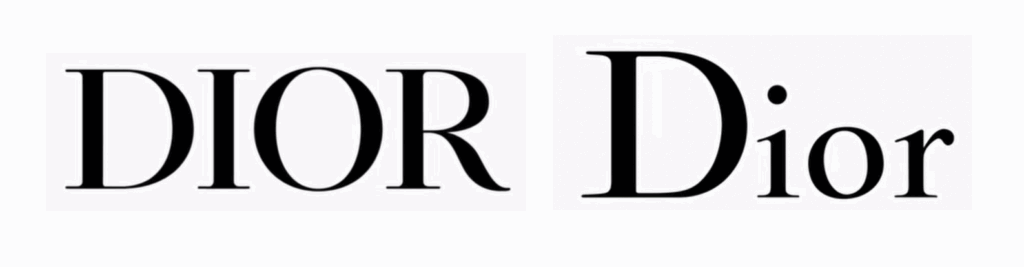
When Jonathan Anderson took the helm at Dior, one of his first statements came in the form of typography. He retired the stylized all-caps DIOR mark, which has been in use since 2018, and restored the original mark chosen by Mr. Christian Dior, himself, in 1946. The revived mark – drawn from the Cochin typeface designed by 18th-century French engraver Charles-Nicolas Cochin – replaces the corporate bluntness of the uppercase word mark with a single capital “D” followed by italicized lowercase letters that feel almost handwritten.
By reclaiming Dior’s original mark, Anderson is rooting the powerhouse in a distinctly French lineage at a moment when so many luxury brands appear adrift in globalized minimalism. The act of restoration is, paradoxically, an act of innovation and a statement that heritage can still feel new. This “step one,” as Anderson called it, is less a cosmetic change in luxury branding than a signal of philosophy: the future of Dior begins with the handwriting of its founder.
Joining Anderson’s returning to stalwart typography, Matthieu Blazy’s earliest move at Chanel reached for an already-established house mark. Blazy hinted at his vision for Chanel in a photo of a Charvet-made shirt, its placket embroidered in the cursive Chanel script used by Gabrielle Chanel. The reference was a subtle but unmistakable callback to the maison’s earliest era, when its name was more signature than logo.
Blazy’s debut show at the Grand Palais expanded on that whisper. Cotton button-downs – created in collaboration with Charvet – were embroidered in that same looping cursive, reviving an early typographic asset.
The Semiotics – and Law – of the Subtle
While Chanel’s legal counsel was quick to lodge trademark applications for registration for the stylized Chanel word mark, filing an application in Switzerland, for instance, just a day after Blazy’s debut, the revival of already-established marks like this one is almost certainly not a move with meaningful legal value; Chanel and Dior are among the most famous luxury brands in the world, with robust, well-established rights that already command broad protection across classes and jurisdictions – regardless of font.
Adding a cursive word mark or in Dior’s case, a treatment that mixes upper- and lowercase “D” forms, may broaden the brand’s trademark portfolio on a micro-level, but it is unlikely to materially change the makeup of these companies’ trademark holdings or their enforcement actions. Famous marks enjoy expansive protection against confusion, dilution, and parasitic uses; additional registrations might make for tidy housekeeping and nice-to-haves for record-keeping, but they are not going to be game-changers on the legal front.

With legal considerations out of the way, it is worth asking what these newly revived marks actually do. The reality is that the introduction and use of an “era-mark” so to speak – even if legally redundant – can be a powerful marketing and a merchandising tool. Beyond generating buzz on social media, such a mark serves to define the tenure of a creative director, anchors editorial storytelling, and creates scarcity within abundance.
It gives collectors and consumers a visual timestamp, sorting product into identifiable eras that shape resale value, exhibition narratives, and historical continuity. And in a crowded, logo-saturated field, typographic nuance – stroke weight, ligature choices, cap conventions – becomes a taste-making device.
The Implications for Authentication
Where this all becomes interesting from a legal POV is authentication. As new creative directors tweak logos and scripts, verification gets trickier. Typography becomes a moving target: letter spacing, terminal shapes in the script, micro-kerning around the “D,” cap-height ratios, even the angle of a flourish can vary by line, factory, or year. This muddies the water to an extent and raises the stakes when it comes to authentication …
> For human authenticators: The reference corpus must expand beyond “the logo” to time-stamped variants, production-locale tells, and packaging/label ecosystems (care tags, heat stamps, swing tags, embossing plates).
> For machine-assisted checks: Computer-vision models and feature libraries need frequent retraining to recognize sanctioned variations and avoid false negatives as legitimate marks evolve.
> For platforms and courts: Provenance frameworks should privilege multi-factor signals (serial/ledger data, NFC/secure chips where available, materials metadata) over logo-heavy indicators, and expert declarations should map brand-authorized typographic drift across dates to minimize confusion.
THE BOTTOM LINE: These luxury branding-centric revivals are intriguing aesthetic and strategic statements. Chanel and Dior already possess the kind of fame-based protection that renders marginal word-mark additions largely non-eventful for enforcement. With that in mind, the reintroduction of early marks is not less a legal maneuver than an assertion of brand identity aimed at engaging consumers through the language of legacy.
Share