

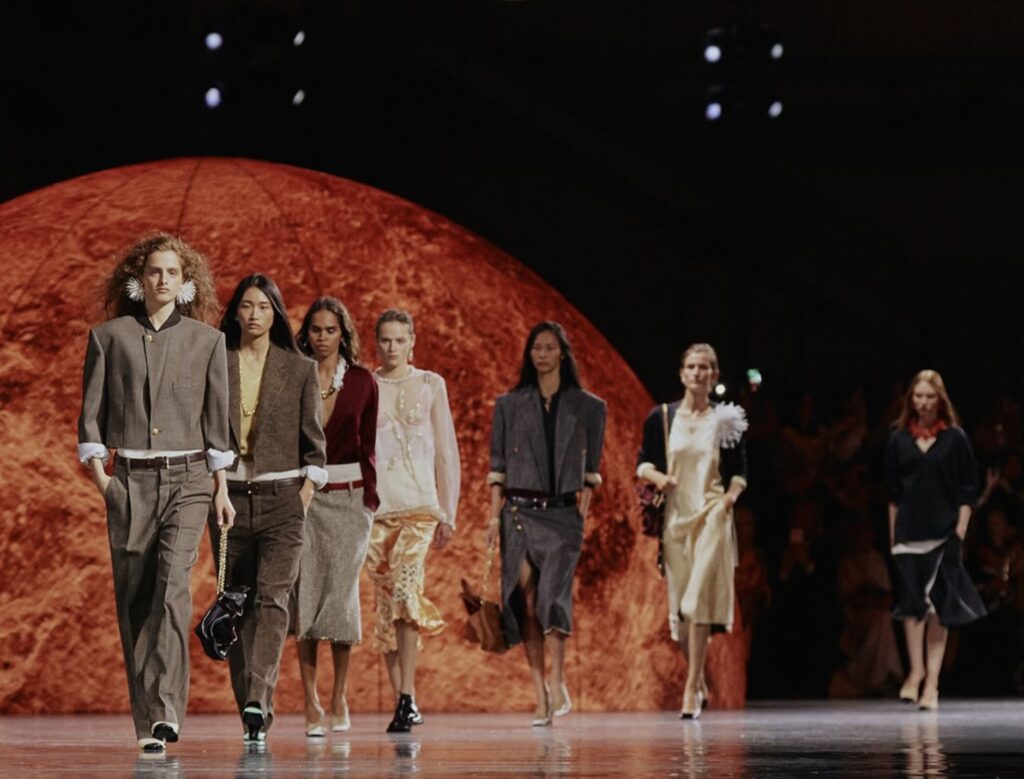
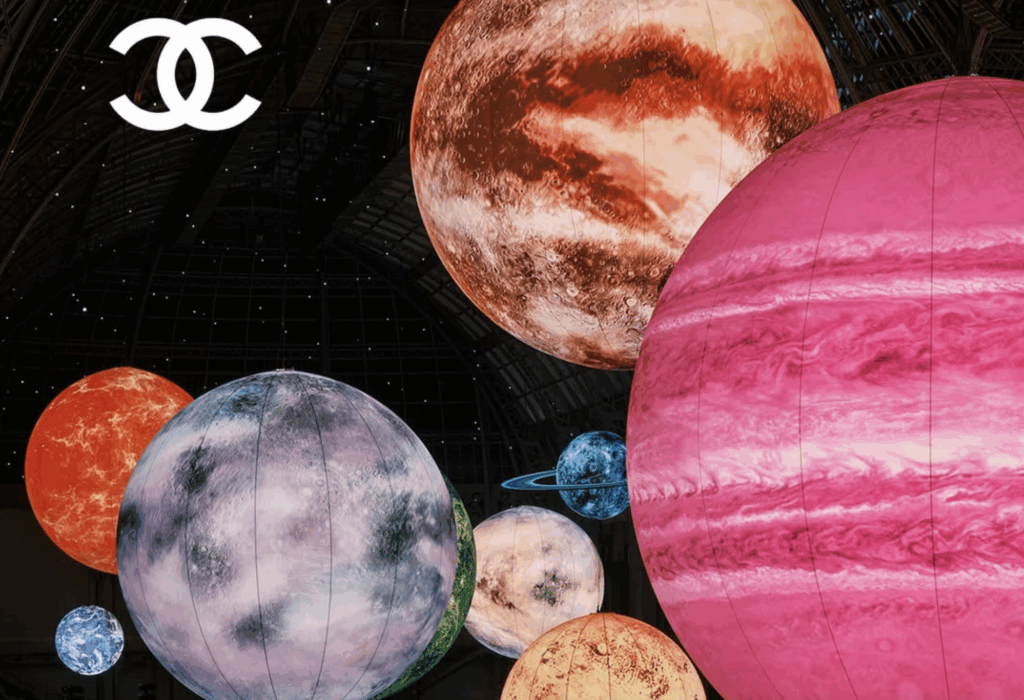
Matthieu Blazy showed his inaugural collection for Chanel on Monday against a backdrop of a glowing solar system. The collection and the luxury powerhouse brand behind it were framed as something beyond fashion – a universe all of its own. “This is a universe, the Universe of CHANEL,” the luxury giant declared in its coverage of the collection’s unveiling. A read between the lines of the cosmic staging appears to underscore Chanel’s intent to position itself not merely as a fashion house but as a self-contained world of meaning, heritage, and control.
The likening of Chanel as a universe bears an array of potential meanings. It could allude to the scale of the challenge facing Blazy, Chanel’s fourth-ever creative director, or be a nod to Karl Lagerfeld’s famous S/S 2017 space-themed Chanel show. But for legal and business minds, the invocation of the “Universe of CHANEL” may serve as a metaphor for something else entirely: the intricate and expansive architecture of the multi-billion-dollar brand itself.
The Legal Architecture of a Universe
To speak of the “Universe of CHANEL” is to speak of an ecosystem of codes – the double C, the camellia, the chain strap, the quilting, the tweed – that transcend seasonal offerings to sustain the house’s enduring economic and cultural power. Chanel sells more than $18 billion worth of tangible products – handbags, jackets, fragrances, and more – each year, but the real value lies in the robust, intangible network of ideas and associations that surround these goods. The house’s core strength has long been its ability to monetize meaning: a particular kind of Parisian womanhood, an enduring vision of freedom and restraint, and the belief that owning a Chanel product confers entry into a timeless cultural order.
In this sense, what Chanel sells is its intellectual property – not only its trademarks and designs, but its entire system of signs and experiences. And this “universe” of IP is a carefully curated construct that must be maintained, policed, and protected – by a global network of creatives, marketers, executives, and lawyers – if it is to remain valuable.
Against this backdrop, the idea of the “Chanel universe” makes sense, as does the aggressive litigation strategy that supports it. The brand has long pursued infringing activity. However, in recent years, its legal actions have expanded far beyond simple anti-counterfeiting enforcement to target where and the conditions under which Chanel-branded products can be sold en masse – a strategy aimed at protecting the valuable nature of its brand name and other assets.
At the heart of this strategy lies a simple premise: a Chanel product is not just an object but a curated experience that stands to loses value when divorced from its approved retail environment. In practice, this has meant targeting unauthorized resellers, parallel importers, and even platforms that traffic in authentic Chanel goods without authorization. The rationale is clear: if the “Universe of CHANEL” is to remain coherent, it cannot be fragmented across uncontrolled retail channels. Every sale outside Chanel’s orbit threatens to erode the delicate balance between scarcity, storytelling, and perception on which the brand’s value depends.
A New Era of Chanel
A new era is afoot with Blazy at the helm. In a market increasingly filled with hyper-aware and discerning consumers, his ability to bring new life to the brand (which he is being hailed as achieving so far) will have a significant impact on its ability to maintain cultural relevance and generate demand. It will also influence how the house continues to define the creative contours of its universe. But in the end, there are arguments to be made that Chanel’s most important product is not the bag or the suit, but the idea of Chanel itself – a self-sustaining world of signs, scarcity, and control.
Share