

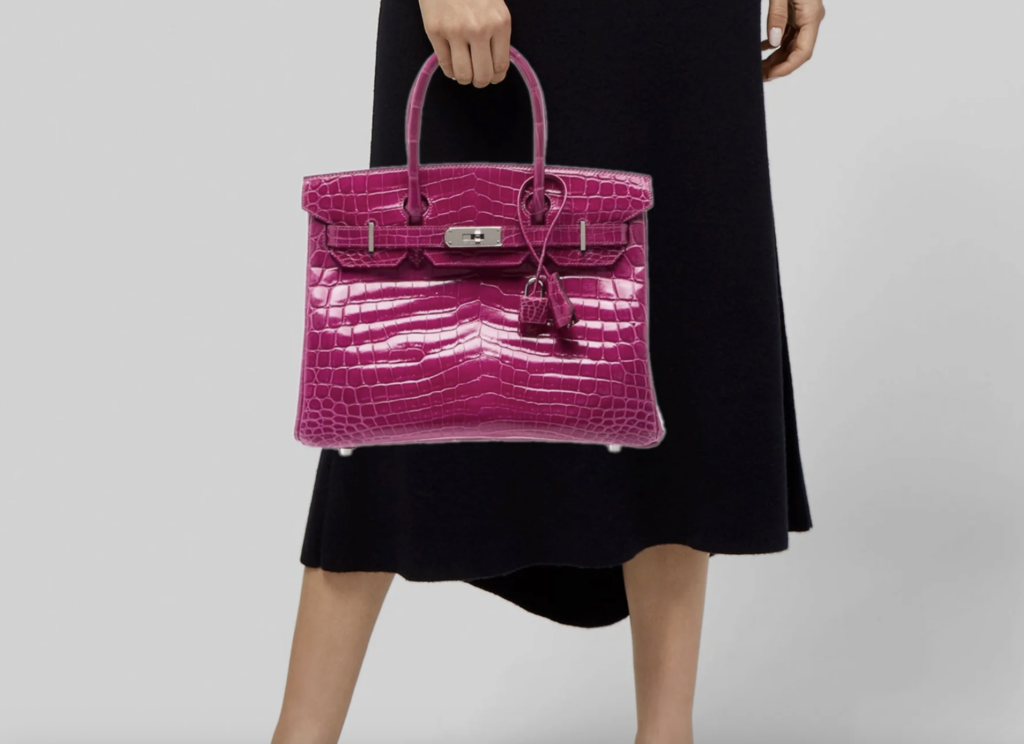
Hermès controls almost every aspect of the market for its most coveted handbags. It determines how many Birkin and Kelly bags it makes, where they are sold, what they cost, and through its closely guarded allocation system, which consumers get the opportunity to buy them. But there is one increasingly important market that operates largely beyond its control: resale.
That disconnect is emerging as a potential issue for Hermès as investors scrutinize whether the luxury goods giant can continue to increase the supply of leather goods without weakening the scarcity and pricing power that underpin their appeal. In a recently-issued note, Jefferies points to a “growing disconnect” between Hermès’ confidence that the market can absorb roughly 6 percent in annual leather capacity additions and investor concerns that resale activity and slowing non-leather sales may signal waning pricing power and a weakening of the quota system.
Against that background, Jefferies raises an interesting possibility: “Perhaps greater involvement in the second hand market (à la Ferrari or Rolex) could be considered as a good course of action?”
The Market Hermès Does Not Control
This tension is not new. In 2019, I wrote in the New York Times about what the rapidly expanding resale market might mean for the Birkin, whose allure has long been tied to carefully controlled supply and the difficulty of acquiring one directly from Hermès. At the time, Flavio Cereda, then managing director of equity research for consumer and luxury at Jefferies International, called resale “the one channel that brands are so far largely unable to mold in terms of either volumes or pricing.”
Last year, I argued that Hermès’ absence from resale was becoming a strategic gap. As Birkins and Kellys proliferated across resale and rental platforms, Hermès had limited ability to shape their pricing, presentation, authentication, or circulation, even as those markets increasingly influenced perceptions of scarcity.
Jefferies is now bringing that same tension into the investor debate. In a September research note, analyst James Grzinic said Hermès remains confident the market can absorb roughly 6 percent in annual leather capacity additions. He forecasts leather sales growth of 10.1 percent in 2026, 9 percent in 2027, and 8 percent in 2028, while expecting non-leather sales to have slowed to minimal growth in the third quarter and sales in China to remain roughly flat.
The question is not simply whether Hermès can sell more bags. It is whether it can increase supply without altering the scarcity dynamics that make those bags so valuable in the first place.
What Resale Is Saying
For now, Jefferies’ own data suggests that concerns about Hermès may be overstated. Birkin auction premiums and average selling prices have rebounded sharply since the end of 2025, while China’s quota-bag market appears to have stabilized after a significant decline earlier this year. These trends illustrate how resale can serve as an independent measure of demand: sustained premiums suggest that consumers remain willing to pay more than retail to acquire bags they cannot readily obtain from Hermès, while falling premiums could signal weakening demand or greater availability.
The challenge for Hermès is that these important signals of demand come from a market it does not control. Hermès can set a Birkin’s retail price, determine production, and dictate who is offered one. But ultimately, once the bag leaves the boutique, the company has little control over its subsequent sale, even as resale transactions inform perceptions of scarcity, desirability, and value. That is what makes Jefferies’ comparison to Rolex relevant. Rolex’s Certified Pre-Owned program creates an official layer within an already-thriving secondary market, giving the Swiss watchmaker a role in authentication, presentation, and the customer relationship without eliminating independent resale.
For Hermès, the question is whether greater control over its secondary market would justify entering a business it has historically left to third parties. And there are good reasons for the company to stay on the sidelines. Hermès benefits when Birkins and Kellys command large resale premiums without assuming the costs or risks of facilitating those transactions. Greater involvement could also make the volume of bags circulating outside boutiques more visible and disrupt some of the opacity that has long worked in the company’s favor.
THE BOTTOM LINE: The conversation around Hermès and resale has shifted from risk to strategy. In 2019, the question was whether the burgeoning resale market could undermine the Birkin’s scarcity. By 2025, I was arguing that Hermès’ absence from that market represented a strategic gap. Now, Jefferies is raising the possibility that the company should enter it as a way to exert greater control.
The bigger shift is that resale is no longer simply a market for Hermès products. It is also becoming a measure of the brand’s strength, offering investors insight into demand, scarcity, and pricing power. For a company whose success depends so heavily on controlling scarcity, having so little influence over that market is becoming very difficult to ignore.
Share