



Over the past two years, a growing number of companies have taken Saks Global and related entities to state court, alleging nonpayment for apparel, accessories, and jewelry that had been sold and delivered. Filed throughout 2024, 2025, and into early 2026, the lawsuits against Saks advance a similar narrative, with vendors claiming that the goods were supplied pursuant to purchase orders, supply agreements, or consignment arrangements. In some cases, plaintiffs allege that they followed up repeatedly and negotiated payment extensions before ultimately resorting to litigation.
Among the cases filed in 2025 are those brought by Jovani Fashion Ltd. and Catherine Regehr, Inc., both of which allege that Saks Global and related entities failed to pay more than $400,000 combined for women’s apparel sold and delivered between late 2024 and 2025. Other suits target Saks Off 5th, including actions by International Trimmings & Labels Inc., which seeks $40,690 for goods sold pursuant to a 2023 invoice, and Criteo Corp., which alleges $251,953 in unpaid fees under digital advertising placement agreements.
Additional complaints span winter accessories, garments, and jewelry, with claimed damages ranging from tens of thousands of dollars to more than half a million dollars.
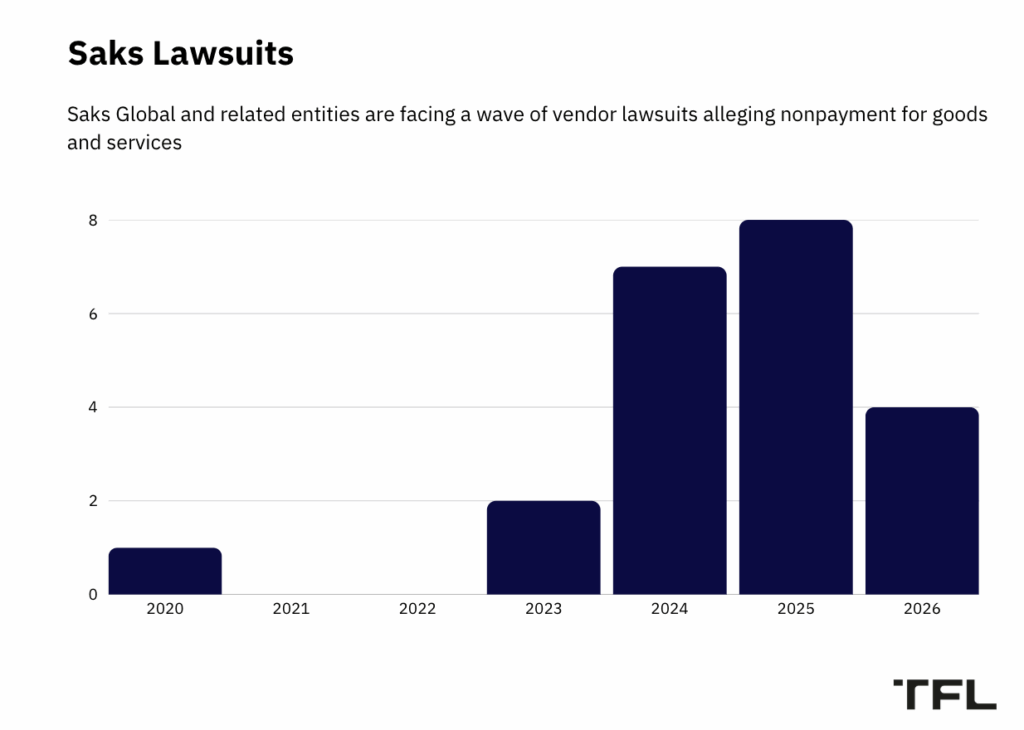
The newest lawsuits on the docket show that Saks’ vendor-payment problems continued into 2026. In early January, designer Gabriella Rossetti, for example, sued over alleged failures to remit customer proceeds and return merchandise under a drop-ship consignment arrangement, while also naming CEO Marc Metrick individually in connection with efforts to resolve ongoing non-payment issues. Days later, Gevril Group accused Saks Off 5th of failing to pay more than $275,000 for women’s apparel sold and delivered in 2025, and Italian hat maker Mr Hatter alleged that Saks entities paid only a fraction of roughly $325,000 in shipments, leaving nearly $248,000 outstanding.
A Complicated Backdrop for Saks
Those disputes are now unfolding against a materially changed legal backdrop. On January 13, Saks Global filed for Chapter 11 bankruptcy protection, following mounting liquidity pressures, including a missed $100 million interest payment and reported efforts to secure emergency financing to continue operations. As of late 2025, a company spokesperson had said that Saks Global was “exploring all potential paths to secure a strong and stable future,” a process that has now formally shifted into court-supervised restructuring.
The bankruptcy filing also follows a significant leadership transition, with longtime chief executive officer Marc Metrick stepping down and co-owner and executive chairman Richard Baker assuming the CEO role.
For vendors already pursuing unpaid invoices, the Chapter 11 filing has immediate procedural consequences. Pending breach-of-contract actions are generally subject to the automatic stay, halting litigation and preventing plaintiffs from continuing to pursue their claims outside the bankruptcy court absent special permission. Instead, vendors must assert their claims through the bankruptcy process.
That shift has meaningful consequences for vendors’ chances of getting paid. In a Chapter 11 scenario, unpaid, pre-bankruptcy invoices are typically treated as general unsecured claims, placing vendors behind secured lenders and other priority creditors in the payment waterfall. As a result, recoveries are often delayed and discounted, with unsecured creditors often receiving only a fraction of what they are owed, if anything at all, after a restructuring plan is approved.
In that context, the lawsuits serve as a pre-bankruptcy signal of the financial strain within the business. For vendors that have already delivered goods, the Chapter 11 filing reframes the dispute from a question of when payment will arrive to whether it will arrive at all, with claims now funneled into a restructuring process that can leave unsecured creditors waiting months (or longer) and facing potentially reduced recoveries.
Updated
January 14, 2026
This article was initially published on January 6, and has been updated with new litigation information and post-cChapter 11 filing context.
Share