

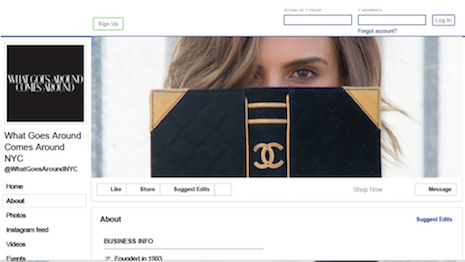
In the wake of a headline-making jury trial, which found What Goes Around Comes Around liable for willful counterfeiting and awarded Chanel $4 million in statutory damages, and a subsequent bench trial that resulted in a sweeping injunction and an order that the reseller be disgorged of nearly $13,000 in profits, the luxury brand and the luxury reseller continue to clash. From the outset, TFL has kept close tabs on the docket of the case (breaking nearly every bit of news in the case since 2018), which is expected to carry significant implications for the luxury resale market broadly. With new activity coming from both Chanel and What Goes Around Comes Around (“WGACA”) as of late, here is a brief of some of the most critical developments …
The Background in Brief: The dispute stems from the lawsuit that Chanel filed against WGACA back in 2018, accusing the reseller of selling non-genuine Chanel products and misleading consumers into believing WGACA was affiliated with Chanel by way of its use of Chanel trademarks and other branding assets. Following years of litigation, a New York federal jury found that WGACA had sold 13 Chanel-branded handbags associated with stolen serial numbers from a Chanel-authorized manufacturer. The jury awarded Chanel $4 million in statutory damages and found WGACA’s infringement of Chanel’s trademarks to be willful. The jury also sided with Chanel on its false advertising and unfair competition claims.
On Feb. 26, the court issued a final judgment, formalizing a jury verdict that found luxury reseller WGACA liable for trademark counterfeiting, false advertising, and unfair competition. The judgment includes a $4 million statutory damages award, $12,739 in disgorged profits, and a sweeping permanent injunction that severely limits WGACA’s ability to market and sell Chanel-branded goods. The injunction prohibits the unauthorized use of Chanel’s trademarks and imagery – including logos, hashtags, and stylized branding – and bars the sale of Chanel items with voided serial numbers or that have been materially altered. WGACA is also required to post clear disclaimers of non-affiliation and is restricted from making authentication claims without supporting records.
> Chanel’s bid for attorneys’ fees: By way of a March 12 filing, Chanel is seeking $6.7 million in attorneys’ fees and costs from WGACA, arguing it is entitled to recover legal expenses under the Lanham Act, which allows fee awards in “exceptional cases.” Chanel contends this case qualifies based on its sweeping legal victories – including a unanimous jury finding of willful infringement on all claims – and its success at every stage of the multi-year litigation, from early motions through post-trial rulings.
Chanel also claims WGACA’s litigation conduct was “unreasonable” and in bad faith, citing false defenses, continued sales of infringing and counterfeit goods during the case, and misuse of its branding by WGACA-affiliated third parties even after the verdict. Chanel argues that WGACA ignored clear warnings and continued its infringing conduct, justifying both a finding of exceptionality under Section 1117(a) and a mandatory fee award under Section 1117(b).
> WGACA’s bid for a new trial and reduced damages: In a trio of filings lodged with the court on March 26, WGACA seeks a new trial and judgment as a matter of law after a jury found it liable for counterfeiting, false advertising, and unfair competition in Chanel’s lawsuit. WGACA argues the verdict is unsupported, as the items were made in a Chanel-authorized factory with original hardware, and that the $4 million statutory damages award is excessive and unconstitutional. In a separate letter, it asks the court to issue formal findings of fact to support its disgorgement ruling, calling them essential for appeal. WGACA also opposes Chanel’s request for attorneys’ fees, arguing the case is not “exceptional” under the Lanham Act, citing the lack of harm, absence of confusion, and disproportionate relief already awarded.
>> The counterfeiting verdict: WGACA argues that the court should overturn the counterfeiting verdict or grant a new trial because the bags at issue were made in the Chanel-authorized “Renato Corti” factory and later stolen. Citing the Lanham Act and Second Circuit precedent, it claims that goods produced in an authorized facility – regardless of whether they passed through Chanel’s quality control – cannot be legally deemed counterfeit. WGACA highlights one such bag that was available at trial contained only original Chanel hardware, a fact conceded by Chanel’s expert after initially testifying otherwise. WGACA contends this undermines Chanel’s counterfeiting claim and misled the jury.
The reseller further argues that Chanel’s counterfeit designation relied solely on its internal ORLI database, to which WGACA does not have access, and that Chanel’s own experts could not identify any objectively fake features beyond those internal records.
>> The damages award: WGACA challenges the $4 million statutory damages award as “so excessive as to violate due process,” arguing that Chanel presented no evidence of actual damages, lost profits, or consumer confusion. It seeks a reduction in damages or a new trial, noting that the verdict concerned only 14 bags out of more than 70,000 Chanel-branded items sold since 2014. This claim supports WGACA’s broader position as a good-faith actor in the luxury resale market, allegedly harmed by Chanel’s refusal to share information that could have prevented the disputed sales—specifically, the serial number range tied to the 2012 Corti incident.
>> A request for judicial findings: Additionally, WGACA submitted a letter requesting that SDNY Judge Louis Stanton issue formal findings of fact and conclusions of law under Rule 52(a), in connection with the court’s judgment on equitable relief. WGACA says that a record of “such findings [is] necessary to ensure that the appellate court can meaningfully review the Court’s conclusions under the applicable legal standards.”
>> Attorneys’ fees: Separately, WGACA is taking issue with Chanel’s bid for attorneys’ fees, challenging Chanel’s characterization of the case as “exceptional” and arguing that its conduct was not egregious, that Chanel suffered no actual harm, and that the litigation was heavily one-sided, with Chanel reportedly spending over $6 million on litigation. WGACA also disputes any presumption that a willfulness finding, alone, makes a case exceptional, citing Octane Fitness v. ICON Health & Fitness and Second Circuit precedent that emphasize a holistic assessment of the facts, equities, and relative litigation conduct.
> WGACA’s Appeal to the Second Circuit: Finally, the reseller notified the U.S. District Court for the Southern District of New York on Thursday that it is appealing to the United States Court of Appeals for the Second Circuit the final judgment and “any and all adverse rulings incorporated in, antecedent to, or ancillary to the Judgment, and from any and all adverse orders, judgments, decrees, decisions, rulings, and opinions” in connection with it.
THE BIGGER PICTURE: This case has become a flashpoint in the ongoing legal and commercial tension between fashion houses and resale platforms. While the jury verdict and final judgment from the court apply specifically (and only) to WGACA, the case, nonetheless, raises broader questions about the obligations of resellers when it comes to marketing and authentication of luxury goods, and also speaks to the accessibility of brand authentication tools and the boundaries of lawful resale in the luxury space.
Whether WGACA will succeed in overturning the verdict or reducing the financial blow remains to be seen, but the filings underscore that even the most established names in resale operate in a legally precarious landscape – one where brand owners are increasingly aggressive in protecting their marks far beyond the point of sale.
The case is Chanel, Inc. v. What Goes Around Comes Around, LLC, et al., 1:18-cv-02253 (SDNY).
Share