



In what is likely to be a closely-watched case, Williams-Sonoma, Inc. (“WSI”) has filed a new lawsuit against Last Brand, Inc., the parent company of Quince. The homewares and furnishings giant accuses the “luxury for less”-focused retailer of engaging in “a widespread false advertising campaign” that leverages WSI’s brand equity while misleading consumers about product quality and pricing. According to WSI, Quince’s business model hinges not just on imitation, but on systemic deception: misleading product comparisons, inflated competitor pricing, and intentionally vague claims that improperly trade on the reputation and goodwill of established home and lifestyle brands.
Setting the stage in the complaint that it filed in the U.S. District Court for the Northern District of California on November 21, WSI claims that it has operated for nearly 70 years as the parent company behind a portfolio of high-end home and kitchen brands, including Pottery Barn, West Elm, Williams Sonoma, and Rejuvenation. More than 90 percent of its offerings are designed in-house and sold exclusively through its own retail channels, a vertically integrated model that WSI says ensures both quality and brand identity.
Quince, WSI says, emerged in 2020 as a dupes disruptor, a fast-growing e-commerce platform offering what it describes as “the same luxury products” at significantly lower prices.
While Quince’s model was initially focused on apparel, it has since expanded aggressively into home furnishings, lighting, rugs, cookware, and beauty. That expansion, according to WSI, has come at the cost of “truthful and fair competition” and has relied on “a widespread false advertising campaign” that “mislead[s] consumers and disparage[s] its brands with false advertising.”
Dubious Side-by-Side Claims, Social Media Smoke & Mirrors
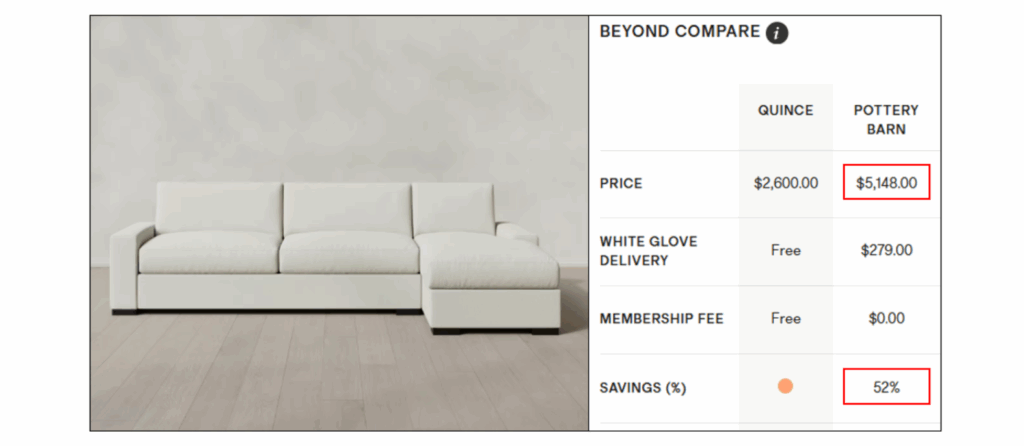
At the center of the lawsuit are Quince’s “Beyond Compare” charts – infographics that, WSI asserts, appear “on almost every product page on Quince’s website” and compare Quince goods to products from “a competing brand,” often one of the WSI portfolio companies. WSI alleges that these charts are problematic because “Quince never identifies the specific product that WSI supposedly charges so much more for than what Quince charges, nor does Quince attempt to substantiate its claim that any WSI product is the same.” And “failure to do so is inherently misleading,” per WSI.
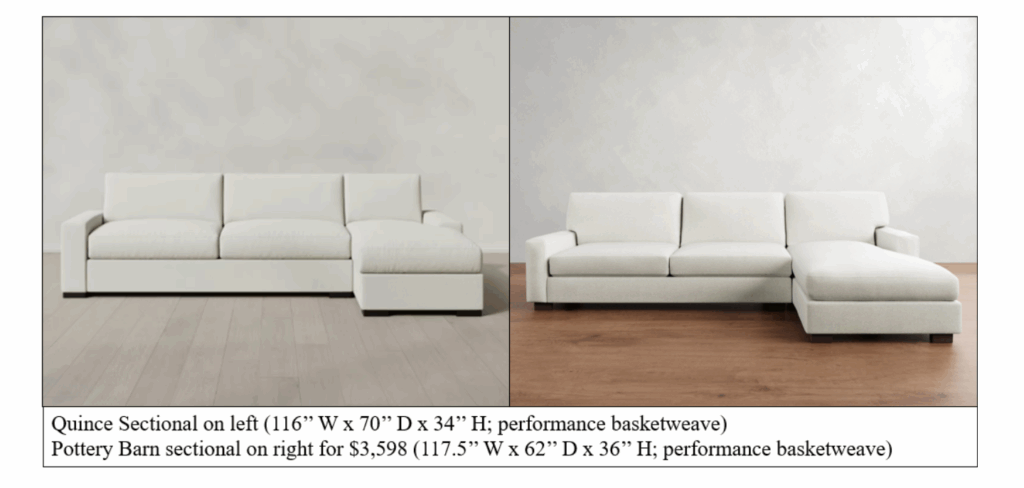
Even where Quince does offer a comparable item, the complaint continues, it “falsely states WSI’s prices” in order to exaggerate the purported savings. For example, WSI notes that “the most similar sectional sold by Pottery Barn actually costs $3,598 – not $5,148 as advertised by Quince.”
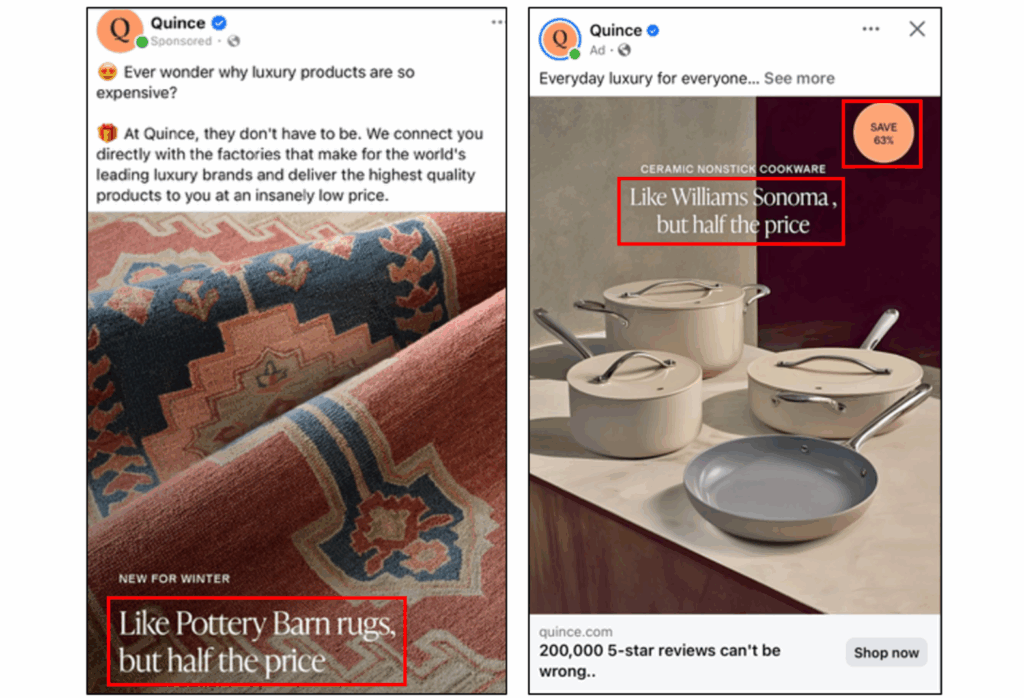
At the same time, WSI also highlights a series of social media ads and influencer-style promotions run by Quince across platforms like Instagram, TikTok, and Pinterest. In one such ad, a customer declares: “Like Pottery Barn rugs, but half the price” – even though the rug shown in the ad has never been sold by Pottery Barn, according to WSI. A similar ad touts a cookware set as being “like Williams Sonoma, but half the price,” again with no actual product correlation.
Other marketing materials feature Quince’s bedding line, with claims like “50% less than Pottery Barn” or “$100 less than West Elm,” despite the absence of any directly comparable products or substantiation. In one Instagram video, Quince asserts that “everything at Pottery Barn was over $280,” a claim WSI rebuts by pointing to similar products that retail for as little as $219.
Manufacturing Transparency – Or Lack Thereof
The complaint also alleges that Quince misrepresents not just comparisons, but its own product attributes, including the materials used and the certifications claimed. Notably, WSI cites Wirecutter’s reporting, which found that Quince advertised towels as made of GOTS-certified organic cotton – only to later admit this was an “error.” Similarly, a GOTS certification number displayed on a Quince sheet set turned out to be invalid. Textile experts interviewed in the same article questioned the plausibility of claims that Quince’s sheets were made from long-staple organic cotton – a rare and costly material pairing not typically available at mass-market price points.
In addition to product comparisons and material claims, WSI accuses Quince of inflating consumer perceptions through manipulated reviews. According to the lawsuit, Quince prominently displays 5-star ratings on product pages while hiding or downplaying lower-star reviews. Still yet, WSI asserts that Quince’s product reviews are also “false and misleading” because Quince fails to disclose that consumers are incentivized to leave reviews via “reward points.”
One advertisement, for example, claims “200,000 5-star reviews can’t be wrong” for a cookware set that, at the time, had only 37 total reviews – several of which were not five stars.
With the foregoing in mind, WSI accuses Quince of false advertising and unfair competition and sets out an addition claim of restitution based on quasi-contract, and is seeking injunctive relief, disgorgement of profits, damages, and attorneys’ fees. While WSI, which recently settled a separate suit against Dupe.com, states that it “welcomes healthy competition and truthful comparative advertising,” it will not permit Quince “to mislead consumers and disparage its brands.”
THE BOTTOM LINE: This case strikes at the heart of an increasingly prevalent phenomenon in consumer markets: the tension between established high-end brands and fast-moving “dupe” challengers who rely heavily on comparison marketing. What differentiates savvy comparison from actionable false advertising, however, is now set to be tested in court.
A spokesperson for Quince told TFL, “At Quince, we keep things simple: great quality, honest prices, and no mystery around what you’re paying for. Our price comparisons do exactly that. They help shoppers make smarter choices. We respectfully disagree with Williams-Sonoma’s lawsuit. Removing markups isn’t a crime; it’s our mission. And judging from our almost 1 million five-star reviews, customers seem to appreciate a little honesty in the home goods aisle. We’ll stay focused on delivering quality and value. No drama required.”
The case is Williams-Sonoma, Inc. v. Last Brand, Inc., 3:25-cv-10118 (N.D. Cal.).
Updated
December 2, 2025
This article has been updated with a comment provided by a spokesperson for Quince.
Share