

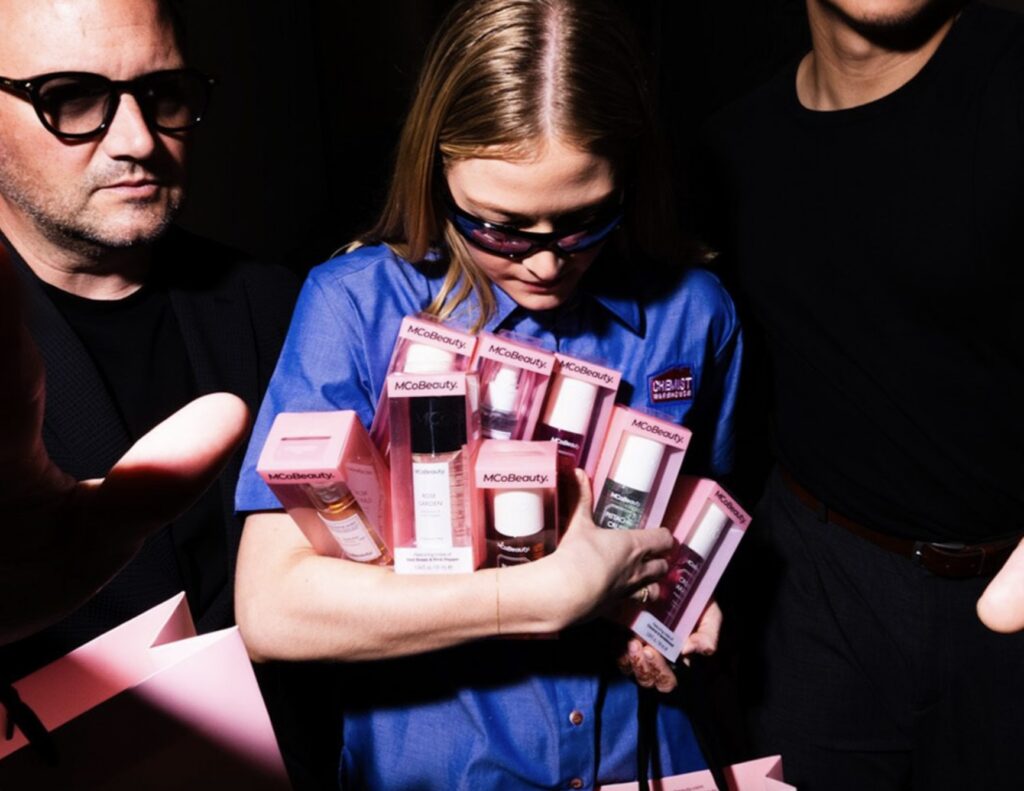
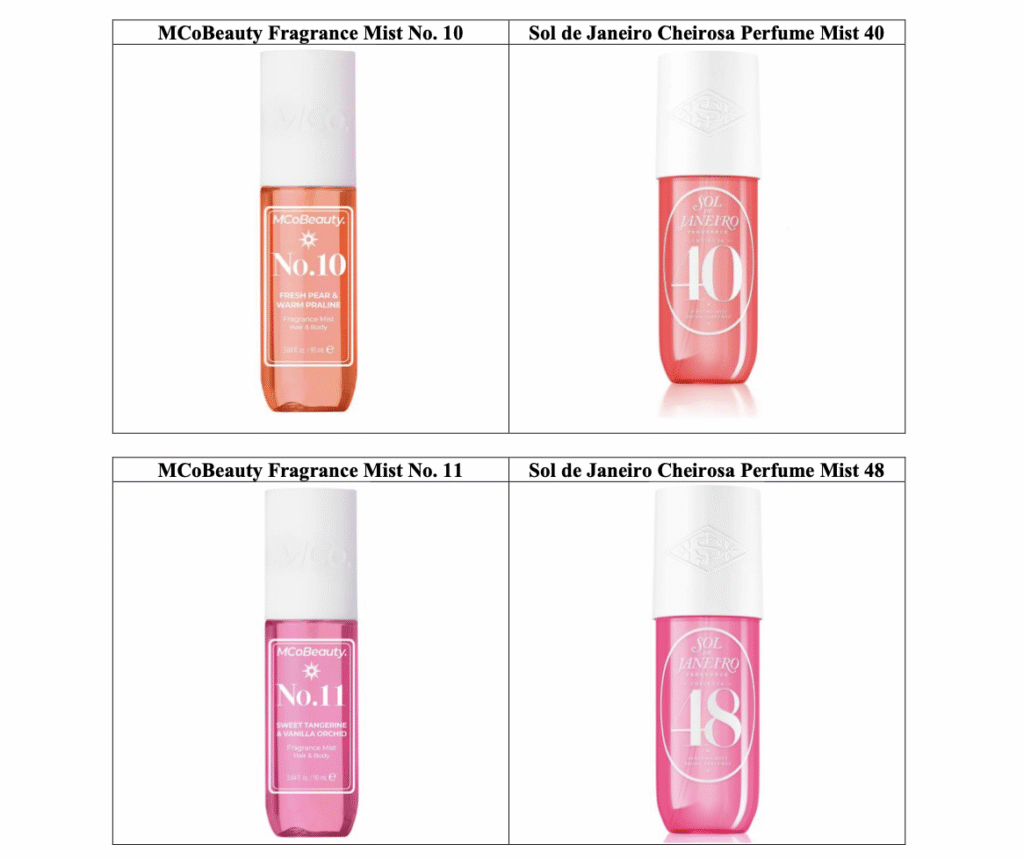
MCoBeauty is pushing back against a trade dress infringement, false advertising, and deceptive practices lawsuit waged against it by Sol de Janeiro, arguing that its alleged “dupes” fragrance mists are not infringing copies, but lawful competitors in an increasingly dupe-driven beauty market. In a newly-filed motion to dismiss, the Australian beauty brand contends that Sol de Janeiro’s lawsuit is a thinly veiled attempt to insulate itself from market competition rather than a legitimate claim under the Lanham Act.
The Background in Brief: Sol de Janeiro (“SDJ”) filed suit against MCoBeauty in November 2024, accusing the “luxe of less” brand of copying the packaging, color schemes, and branding of its Cheirosa body mist line. In an amended complaint in November 2025, SDJ alleges that MCoBeauty is engaging in a coordinated campaign of influencer marketing, curated consumer reviews, and comparative advertising designed to trade on its goodwill, mislead consumers, and violate trademark law and the FTC’s endorsement guidelines.
Dupe Culture or Deceptive Conduct?
Setting the stage in the motion to dismiss that it lodged with the Southern District of New York on January 27, MCoBeauty positions its business model as openly drawing from trends popularized by higher-priced brands, arguing that this positioning is both transparent and legally above board. Beyond that, it maintains that “dupe culture” is a widely recognized phenomenon in beauty retail, “encouraged by social media influencers and viral posts,” and embraced by a generation of consumers who seek out alternatives – not infringing goods.
Citing a 2023 Business Insider survey, MCoBeauty notes that 71% of Gen Z and 67% of millennials regularly purchase “dupes” of more expensive beauty products,” stating that the growth in dupe culture “reflects ordinary competition, not deception.”
Pushing back against SDJ’s false advertising claim, which focuses on influencer and customer claims that MCoBeauty’s products “smell exactly like” or outlast the SDJ ones, MCoBeauty argues that none of these statements originated with the company itself. In one example, influencer @laurenilord compares the two products, stating they “smell exactly” alike, language that MCoBeauty frames as puffery, not fact.
The company also emphasizes that consumer reviews – another source of allegedly “false” claims – are subjective and cannot reasonably be construed as the company’s own speech under the Lanham Act. Citing Second Circuit precedent, MCoBeauty argues that the statements at issue are “expressions of consumer enthusiasm, not literal falsehoods,” and that “the law does not provide relief where an influencer or reviewer merely shares a subjective impression of scent similarity.”
MCoBeauty’s motion also takes aim at SDJ’s trade dress claim (echoing its earlier answer and counterclaims), arguing that the alleged design elements – like bottle shape and font – are generic, functional, and unprotectable. MCoBeauty emphasizes that the trade dress is unregistered and that SDJ has failed to allege non-functionality or secondary meaning.
Perhaps most striking is MCoBeauty’s challenge to SDJ’s standing. To maintain a Lanham Act claim, plaintiffs must show injury in fact. But here, MCoBeauty argues that SDJ has failed to do so, pointing to the brand’s own description of its surging sales figures: over $450 million in revenue in just six months, and a 19% year-over-year increase in U.S. sales.
“There are no allegations that SDJ’s sales were negatively impacted,” the motion states. “In fact, SDJ undermines its own claim of harm by boasting of its success.”
THE STAKES: The case gets to the heart of a broader tension in the modern beauty industry, where the line between inspiration and imitation is becoming more and more blurred. As the court considers MCoBeauty’s motion to dismiss, the underlying legal question is not whether the mists resemble each other, but whether consumers are misled – and whether trademark and advertising law should protect market incumbents from competition that is intentional but not deceptive.
The case is Sol De Janeiro, Inc. v. MCoBeauty Pty Ltd, 1:24-cv-08862 (SDNY).
Share