

Louis Vuitton and Pharrell Williams are looking to escape a case waged against them for allegedly infringing Coogi’s copyright and trade dress by releasing sweaters that mimic its iconic knitwear. In a motion to dismiss, the luxury goods giant and its menswear director call foul, arguing that Coogi is attempting to claim exclusive rights over an undefined, functional aesthetic – lacking protectable expression, consistent use, or secondary meaning – and that the designs at issue are so dissimilar consumers are not likely to confuse them.
Not limited to a fight over a single copyright-protected pattern, Louis Vuitton and Pharrell argue that Coogi – a brand known for its bold, textured knitwear famously worn by hip-hop icons of the 1990s – is attempting to leverage intellectual property law to monopolize an entire visual language rooted in vague, functional design elements that shift across seasons and styles, and that ultimately, fall outside the scope of copyright infringement and trade dress protection.
The Background in Brief: Coogi filed suit against Louis Vuitton Malletier, Louis Vuitton USA, and Pharrell Williams in the Southern District of New York in May. It claims that several garments in Louis Vuitton’s F/W 2025 menswear collection infringe its IP. Specifically, Coogi’s case hinges on a single registered copyright: a 2014 sweater design created in collaboration with Rag & Bone, and alleged trade dress rights in an unregistered design aesthetic described as multicolored, three-dimensional, and intricately patterned knitwear.
Can’t Protect a Vibe
Setting the stage in their October 17 motion to dismiss, Louis Vuitton and Pharrell argue that Coogi is not accusing them of copying a specific sweater but borrowing a vibe. The problem, per Louis Vuitton and Pharrell, is that “you cannot infringe a style – whether through copyright or trade dress.” Yet, that is “exactly what COOGI claims happened here,” the defendants assert, claiming that “COOGI is trying to monopolize an aesthetic.”
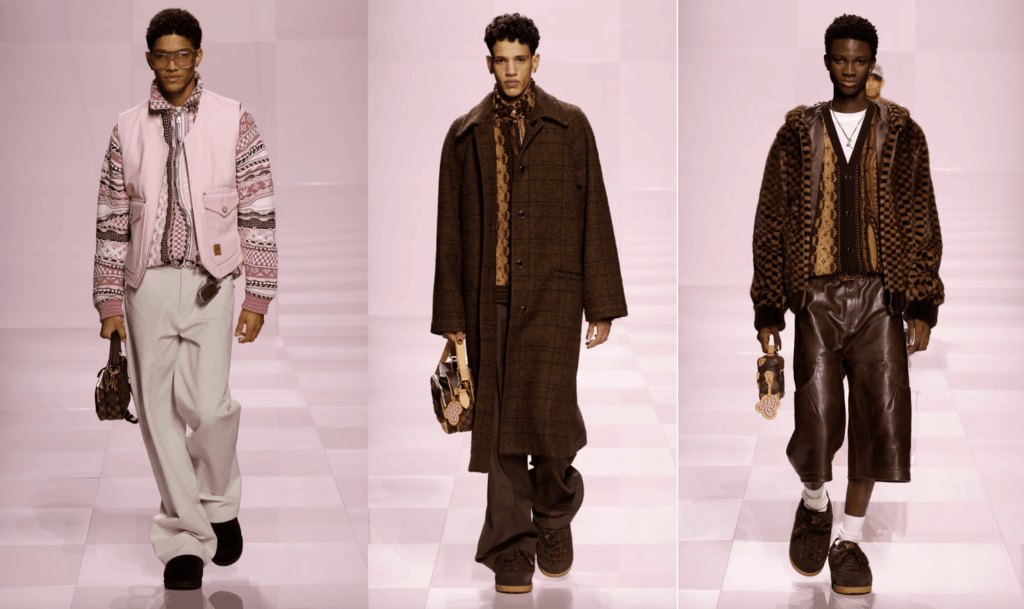
Turning to Coogi’s copyright infringement claim, LV and Pharrell argue that the plaintiff falls short here because the Louis Vuitton garments at issue look nothing like the Coogi work in any protectable sense. Even Coogi “admits the [Louis Vuitton] designs were transformed and changed, not duplicated,” the defendants state, noting that courts in the Second Circuit “consistently hold that rearranging or adapting general stylistic techniques does not amount to copying protectable expression.”
A side-by-side comparison provided by Louis Vuitton confirms that the accused designs incorporate different colors, motifs, and Vuitton-specific branding, including the monogram and checkerboard pattern.
>> In short, the garments may draw inspiration from a similar aesthetic, but they do not replicate any protectable elements of Coogi’s work – and that distinction, according to the defendants, makes all the legal difference.
No Legally Recognizable Trade Dress
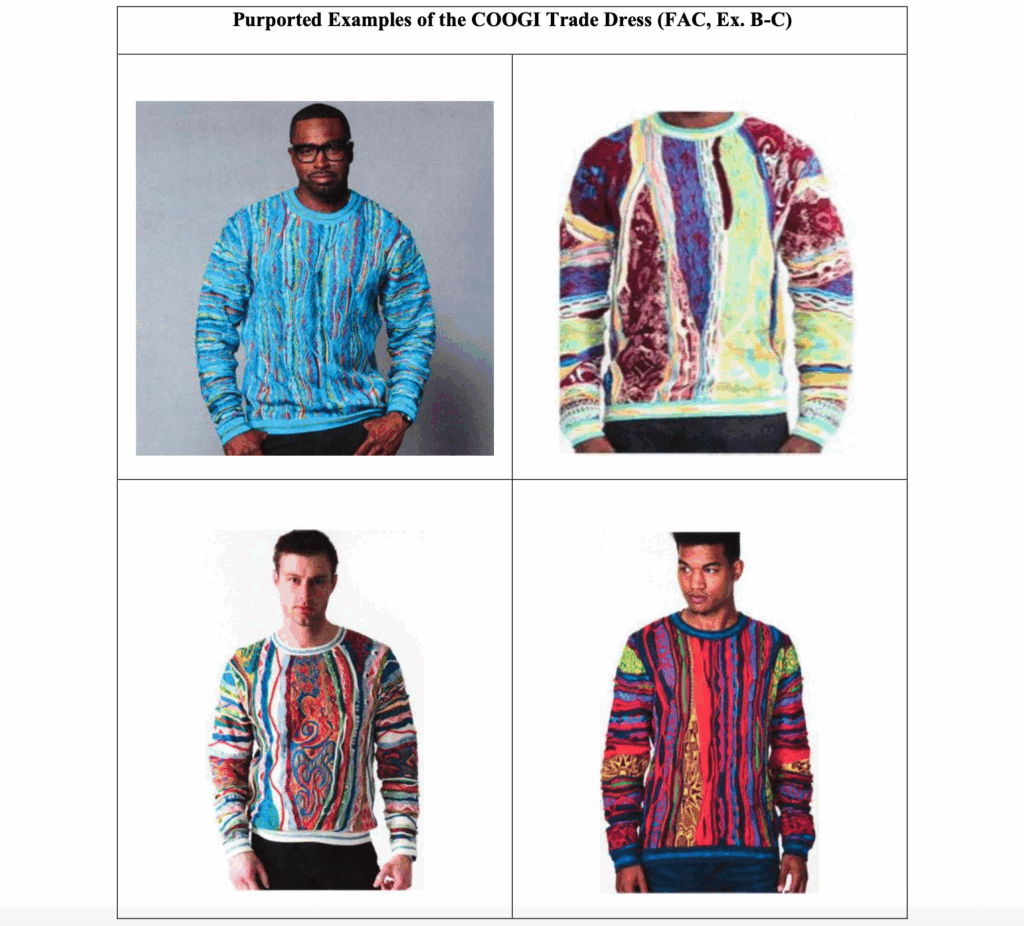
Coogi also claims trade dress rights in what it characterizes as a signature design style, but Louis Vuitton and Pharrell push back here as well. They argue that Coogi’s trade dress is too vaguely defined – “colorful,” “ornamented,” “intricate designs,” and “three-dimensional” – to be protected. And at the same time, it is too inconsistently applied to warrant protection, with Louis Vuitton and Pharrell arguing that the examples Coogi relies on to show use of the trade dress span decades of knitwear, each with materially different designs, palettes, and layouts.
Trade dress law protects specific, nonfunctional, consistent combinations of visual elements that consumers associate with a single brand. Coogi, however, does not offer any fixed configuration or pattern, according to Louis Vuitton. Instead, it points to a constantly changing mix of designs, each one materially different from the other.
And still yet, Louis Vuitton argues that a number of the design features that Coogi does highlight – raised welts, vibrant colors, three-dimensional texture – are functional or ornamental, not source-identifying. These features serve visual or structural purposes, not branding ones. Under established law, trade dress cannot be used to monopolize common design techniques or artistic flourishes that other designers rely on.
Without a clearly defined, consistently used, and nonfunctional set of visual elements, Louis Vuitton and Pharrell argue that Coogi’s trade dress claim amounts to nothing more than an attempt to lock down a general look – which the law does not allow.
No Secondary Meaning, No Confusion
Even if Coogi had clearly defined its trade dress, it would still need to show that the public recognizes that design as uniquely Coogi. That is the legal requirement of secondary meaning – and according to the defendants’ motion, Coogi has not met it.
Louis Vuitton and Pharrell argue that the complaint does not include any consumer surveys, advertising expenditures, or factual evidence that the public associates the alleged design with Coogi as a brand. Instead, it relies on media references and social media comparisons describing the Louis Vuitton garments as “Coogi-inspired.” But recognition of a general style, they argue, is not proof of source, and none of these statements suggest that consumers believed Coogi made or endorsed the Louis Vuitton garments.
Moreover, Vuitton’s own branding is prominently displayed on the garments. The designs feature the Louis Vuitton name, monogram, and checkerboard pattern – all core brand signatures that clearly identify their origin. In that context, the likelihood of consumer confusion is described in the motion as implausible, particularly given the nature of the market.
Louis Vuitton and Pharrell also argue that the products in question exist in entirely different markets. The Louis Vuitton garments were shown on a global runway and sold at luxury price points – reportedly upwards of $1,800 – through high-end retail channels. Coogi’s products, by contrast, are generally mass-market and priced for a different consumer base. The defendants maintain that courts routinely view these kinds of differences in branding, pricing, and sales environments as strong factors weighing against any plausible claim of consumer confusion.
Taken together, the lack of secondary meaning, the absence of confusion, and the clear branding present in the Louis Vuitton designs form what the defendants argue is a fatal blow to Coogi’s trade dress claim.
The case is Coogi Partners, LLC v. Williams et al., 1:25-cv-03837 (S.D.N.Y.).
Share