

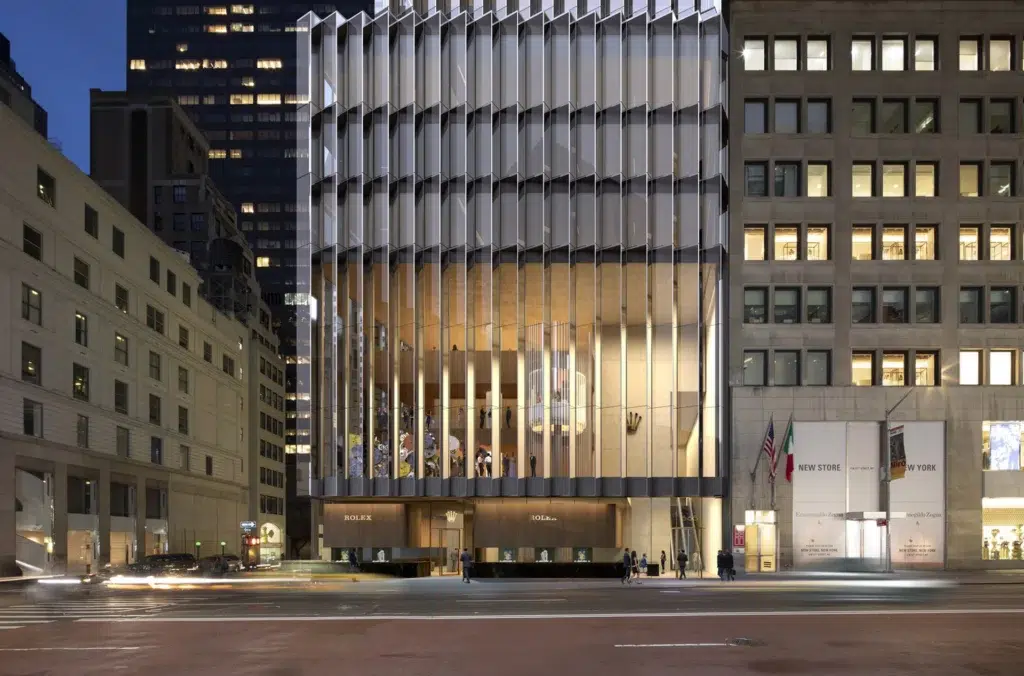
Rolex’s new U.S. headquarters and global flagship on the corner of 5th Avenue and 53rd Street is fast becoming one of New York’s most anticipated luxury landmarks. Designed by David Chipperfield Architects and slated to open at the end of 2026, the 30-story building will unite the Rolex corporate offices with a four-floor flagship, its largest retail outpost in the world. The sleek, glass-clad structure – which replaces the existing building that has been occupied by Rolex since the 1970s – reflects Rolex’s ambition to turn architecture into a symbol of its “quality, precision and excellence.”
Behind the headline-making construction of the sweeping Fifth Avenue tower – complete with an anticipated LEED Platinum certification – lies a strategic, brand-focused effort. The company has filed U.S. trademark applications for “The Rolex Building” and “The Rolex Building Fifth Avenue” for use in connection with “real estate services, namely, rental, brokerage, leasing and management of commercial property, offices and office space,” signaling an intent to formally own not just the architecture, but the identity and narrative surrounding it.
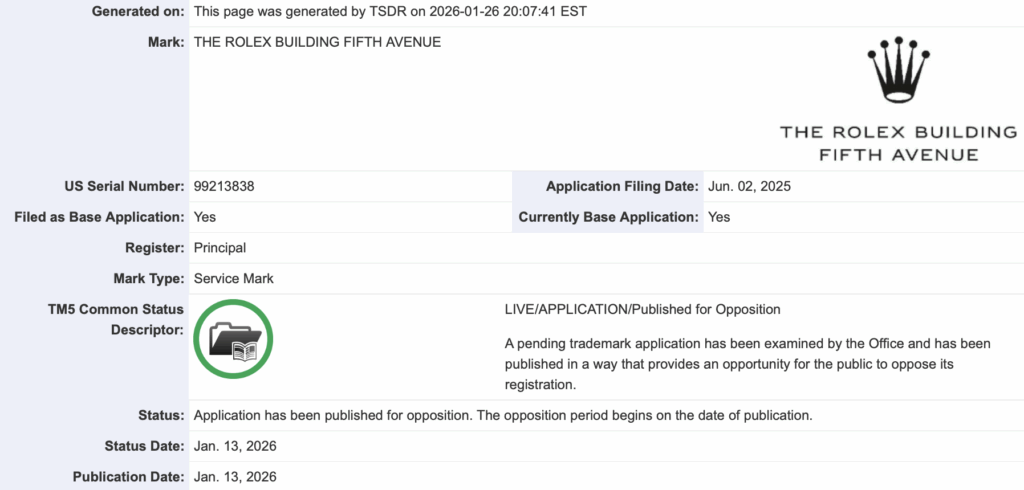
While the current applications – which were published for opposition in early January 2026 – are aimed at real estate services rather than retail operations, the hulking tower’s role as Rolex’s largest global store makes it likely that the company will amass additional rights in “The Rolex Building” if/when it begins using the mark in connection with the marketing and sale of watches, thereby, aligning the building’s name with consumer-facing retail and experiential uses.
In doing so, Rolex is transforming its new Manhattan headquarters from a physical landmark into an intellectual property asset – turning the building into something legally protectable and unmistakably Rolex.
From an Address to an IP Asset
Luxury groups have long treated prime real estate as a cornerstone of brand equity – showrooms as stage sets, façades as billboards, and landmark addresses as three-dimensional brand signatures. Control over these spaces allows brands to dictate every visual and experiential element, from storefront design to neighboring tenants, and to insulate themselves from landlord-driven limitations. Such ownership gives retailers “more control and certainty over their physical presence – a key component of their brand,” per Bloomberg.
LVMH is the master of this model, controlling Paris icons, such as La Samaritaine, which it redeveloped into a mixed-use luxury hub, and 30 Avenue Montaigne, Dior’s restored headquarters and museum. The group also spends aggressively to secure premier corners in global cities, purchasing about €2.45 billion ($2.66 billion) in real estate in 2023, alone. As Bernard Arnault told analysts in 2024, “We’re trying to secure and to buy the best possible locations for our companies,” noting specifically that LVMH holds several of the best corners on Fifth Avenue.
Kering and Richemont follow similar strategies, with Kering, whose portfolio is currently in flux, acquired an 18th-century palazzo on Via Montenapoleone in Milan for roughly €1.3 billion as part of what it described as a “selective real estate strategy, aimed at securing key highly desirable locations for its Houses.” The property joins other prime holdings on Place Vendôme and Avenue Montaigne, in which Kering currently maintains a minority stake. Richemont, meanwhile, leverages crown-jewel sites, such as Cartier’s Fifth Avenue mansion (acquired in 1917 in the famed pearls-for-property deal) and Van Cleef & Arpels’ historic home at 22 Place Vendôme, as part of its overarching luxury strategy.
These holdings illustrate how blue-chip addresses function as a strategic imperative – real estate as both marketing canvas and strategic instrument. In that context, Rolex’s move to use and register “The Rolex Building” as a real estate-centric mark fits squarely within luxury’s real-estate-as-equity playbook, but it also leaves the door open for a second act.
Should Rolex ultimately add retail and experiential services to its uses of the mark, the Fifth Avenue tower would not only anchor the brand physically – it would function as a fully branded destination with layered trademark protections, allowing Rolex to exert control over how the building’s name is used, tightening its hold on every aspect of the flagship’s identity.
THE BOTTOM LINE: It is a subtle but strategic evolution – from owning Fifth Avenue real estate to owning the name, narrative, and commercial halo that surround it.
Share