


Reebok’s recent jump into the smart-ring market has already landed it in hot water. Oura has filed a sweeping patent infringement lawsuit accusing Reebok and several affiliated UK entities of releasing a ring that co-opts the Oura Ring’s core technology, internal architecture, and even its sizing kit. In a lengthy complaint filed in a federal court in Texas, Oura claims the Reebok Smart Ring is “nothing more than an imitation product” built to trade on the appeal of the Oura ring, as well as the decade of R&D and the portfolio of more than 100 patents that is behind it.
In the complaint it filed in the Eastern District of Texas on Monday, Oura alleges that Reebok International Limited, RILUK IPCO Limited, The Original Fit Factory (“TOFF”), and Truconnect knowingly built and are actively marketing a product that imitates the Oura Ring in “its appearance, structure, and functionalities.” Specifically, Oura claims that Reebok’s ring uses the same combination of infrared PPG sensors, skin-temperature sensors, optical electronics, and a 3D accelerometer as its own ring.
In fact, Oura claims that Reebok adopted a curved battery layout and titanium housing that match Oura’s patented engineering. Oura says even the color palette tracks its own. And going even further, Oura claims that Reebok even copied “the layout and design of [its] sizing kit.”
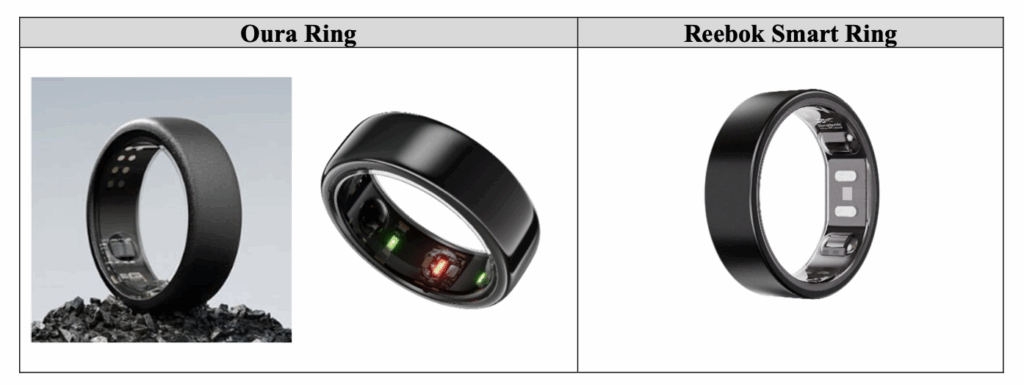
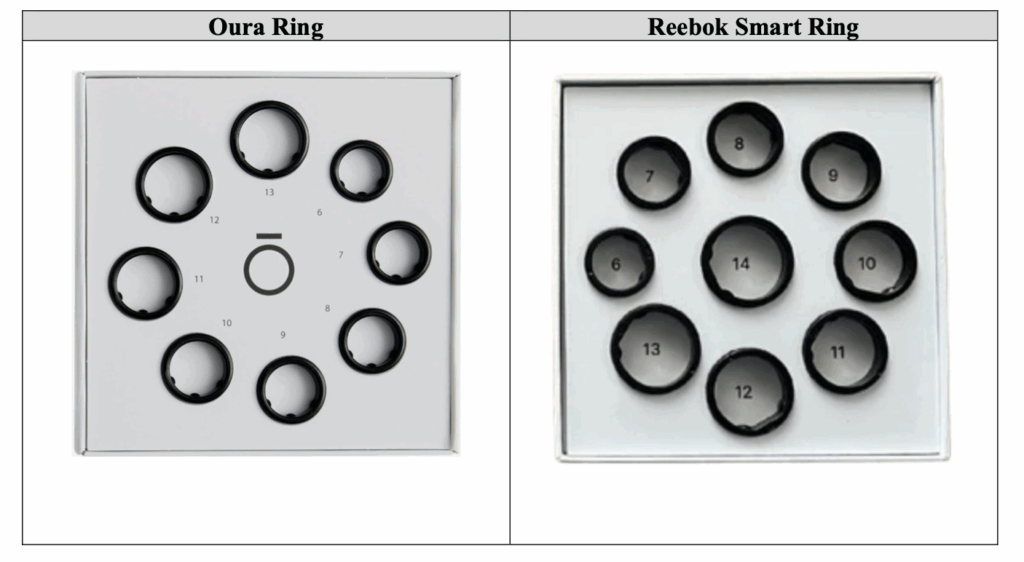
Taken together, Oura asserts that this all “results in the Reebok Smart Ring having an identical look and feel to the Oura Ring.” In making and selling the copycat ring, Oura alleges that Reebok and the related entities have infringed eight of its utility patents, which cover the structure and electronics of its smart ring, as well as the manufacturing-method for how it is constructed. With that in mind, Oura accuses Reebok and its affiliates – which it says operate as a coordinated commercial group responsible for the ring’s design, production, and sale – of direct infringement, inducement, and contributory infringement and argues that their conduct is willful.
Oura is seeking damages and a jury trial in connection with its infringement claims.
The same say as it filed suit against Reebok in Texas, Oura announced that it filed a complaint with the U.S. International Trade Commission against Samsung, Reebok (Reebok Smart Ring), Zepp Health (Amazfit ring), and Nexxbase (Luna ring) for “the unlawful importation and sale of products that infringe on several of Oura’s patents.” The company confirms that “these patents relate to the Oura Ring form factor, including internal and external components, as well as manufacturing methods.”
The Larger Landscape
Oura contextualizes its case against Reebok within a larger pattern it says has emerged as the smart-ring market has grown. Setting the stage in its complaint, Oura asserts that its success has “attracted copycatsseeking to benefit from the market that Oura built through innovation and hard work.” It also underscores the scale of its IP portfolio and its history of enforcing it. Oura – which recently nabbed a $10.9 billion valuation in a Series E round – notes that it holds “over a hundred patents worldwide related to the structure, design, and manufacturing of smart ring wearables” and that it routinely protects those rights “through licensing and/or litigation.”
Several competitors, it adds, have already taken licenses “in the recent past,” including “well-known smart ring manufacturers.”
Against that backdrop, Oura frames the dispute as part of what it calls a growing wave of “copycats” seeking to benefit from the market it says it built “through innovation and hard work.” It highlights its high-profile win at the U.S. International Trade Commission (“ITC”), in which Ultrahuman and RingConn were found to infringe Oura’s U.S. Patent No. 11,868,178. The ‘178 patent extends to “a finger-worn wearable ring device” and “ensures the inclusion of a battery, printed circuit board, and one or more sensors between an internal and external housing of a wearable ring device.”
That case, Oura notes, “was widely publicized in the industry,” making it so that Reebok would have been aware of it and of Oura’s patents as a result. Despite that, Oura says that Reebok moved into the category with a ring that tracks the same health metrics in the same way, allegedly infringing the very same patent as the one at the heart of the ITC case.
TL/DR: Oura frames Reebok not as a new entrant pushing into the smart ring market with independent technology, but as the latest company attempting to make use of Oura’s IP without authorization.
The case is Ouraring Inc. v. Reebok Int’l Ltd., 2:25-cv-1129 (E.D. Tex.).
Share