



Quince has prevailed – for now – in a false advertising lawsuit over the comparative marketing at the center of its “luxury for less” model. In a newly-issued order, Judge Edward J. Davila of the U.S. District Court for the Northern District of California granted Quince’s motion to dismiss claims brought by Williams-Sonoma, Inc. (“WSI”), finding that WSI failed to plausibly plead actionable false or misleading advertising. The court gave WSI a chance to amend its complaint, leaving the door open for the retailer to rework its claims.
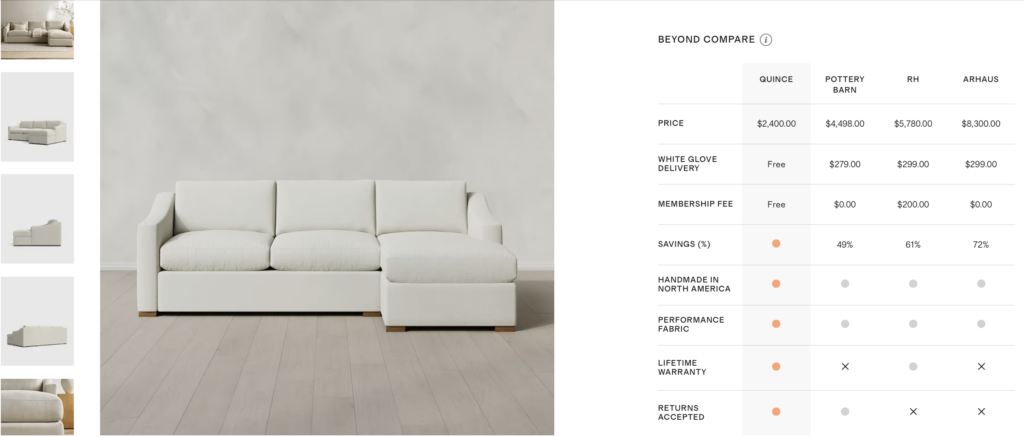
The case got its start in 2025, when WSI accused Quince of carrying out a “widespread false advertising campaign” by comparing its products to WSI’s offerings and suggesting that consumers could get the same goods for substantially less. Among WSI’s key qualms: Quince’s “Beyond Compare” charts, which compare Quince goods with competing products based on price, delivery costs, warranties, and other attributes.
Quince moved to dismiss the case in January, arguing that its ads do not claim that its products are identical to WSI’s and that the complaint lacked factual support for its allegations about inferior quality and misleading prices.
When “Like” Does Not Mean “Identical”
In his September 30 order, Judge Davila rejected WSI’s argument that Quince’s charts communicate that the companies sell the same products. Viewed in context, the court found that the charts identify similarities and differences between competing products rather than represent that they are identical. The same issue surfaced in Quince’s social media advertising. The Pottery Barn, West Elm, and Rejuvenation-owner challenged ads stating, “Like Pottery Barn rugs, but half the price,” on the basis that they falsely suggest consumers can buy the same items from Quince. The court disagreed, finding that “like” means “similar to,” not identical to.
The homewares and furniture company also challenged an ad stating that a Quince duvet cover was “50% less than other brands for the same product.” The court found that “same product” could mean the same type of product rather than an identical item, making the phrase ambiguous and defeating WSI’s literal-falsity theory. WSI “may have a more viable argument” that the statement was misleading, Judge Davila said, but it had not alleged specific facts showing a tendency to deceive a substantial segment of consumers.
Price and Quality Claims Fall Short
WSI separately argued that Quince’s comparisons are misleading because its goods are inferior. But the complaint lacked facts establishing the comparative quality of the companies’ products, according to the court, and the negative reviews WSI cited were not enough to support an inference that Quince products are objectively inferior or that consumers had been misled.
WSI’s pricing allegations also fell short. Quince listed a Pottery Barn comparison price of roughly $599 for a handwoven jute rug, while WSI pointed to a $399 Pottery Barn rug that it said had similar attributes. Quince identified another $599 Pottery Barn rug that it said had the same attributes as its own. The existence of similar WSI products at lower prices, Judge Davila found, did not make it plausible that Quince had advertised false prices.
WSI fared better on one allegation about Quince’s reviews. It plausibly alleged that an ad claiming a duvet cover had more than 1,000 five-star reviews was false because the product allegedly had fewer at the time. But WSI did not sufficiently plead materiality or injury.
THE STRATEGY: Quince’s use of a competitor’s name alone did not carry WSI’s claims. The court made clear that the complaint still needs facts plausibly showing that Quince’s particular comparisons were false or misleading, and Rule 9(b)’s heightened pleading standard put additional weight on that detail.
For brands looking to challenge this kind of comparison marketing (as one way to address the robust market for dupes), the facts behind individual claims will be critical – from product characteristics and historical pricing to testing and consumer evidence. Where the language is ambiguous rather than literally false, allegations showing a tendency to deceive a substantial segment of consumers become particularly important.
For companies using dupe-style marketing, the wording of the comparison matters, too. Calling a product “like” another brand’s offering presents a different false advertising question than making verifiable claims about price, materials, quality, or other attributes. The more concrete the comparison, the more there is for a competitor to test.
The case is Williams-Sonoma, Inc. v. Last Brand, Inc., 3:25-cv-10118 (N.D. Cal.).
Share