

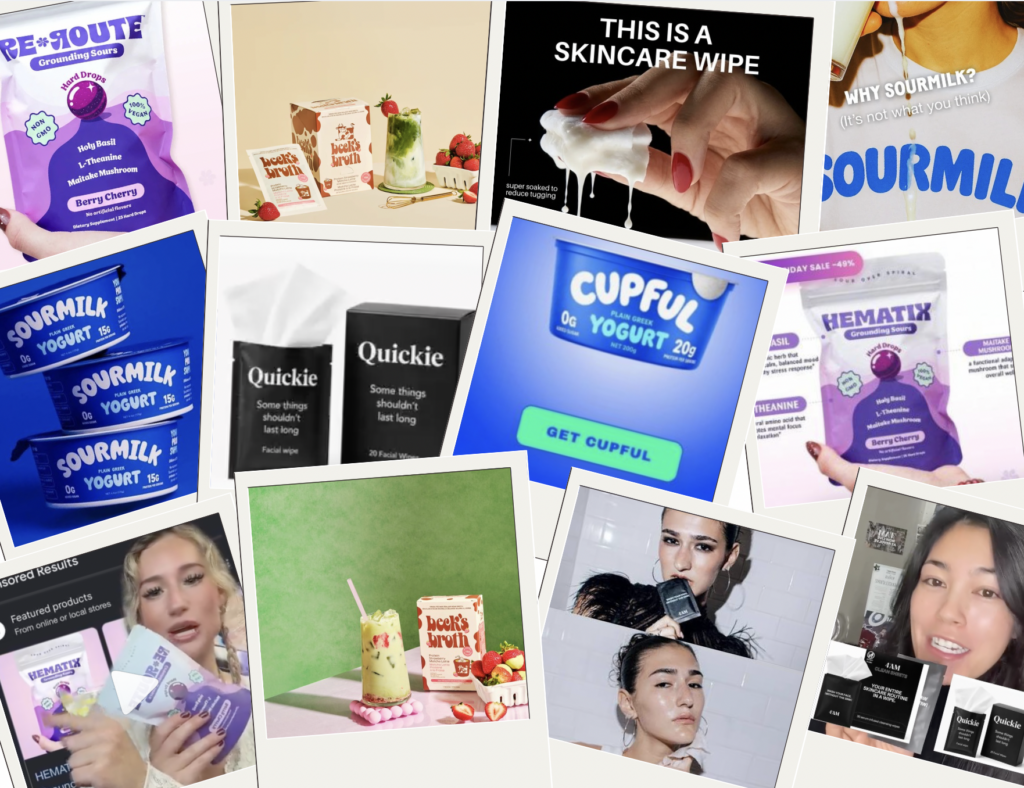
Brands are taking to social media to accuse competitors of copying their visual identities – from packaging and logos to websites and marketing imagery. Recent allegations that buzzy young brands like Sourmilk, 4AM Skin, Beck’s Broth, and Re Route have been copied highlight the issue. In the case of Sourmilk, the founder of yogurt startup Cupful attributed the replicated branding to AI, claiming she had never heard of Sourmilk.
Pointing to AI as an explanation for allegations of copying raises a question: When AI generates lookalike branding, is it reproducing something the user asked for, something it learned during training – or both?
The Question of Training Data
AI-generated branding could resemble an existing brand even when the user never instructed the model to copy it. Generative AI systems are trained on vast datasets, potentially including brand websites, product photography, packaging, and advertising. That training could contribute to similarities, although resemblance alone does not establish that a model encountered the branding at issue.
The allegations come against the backdrop of widespread litigation over AI training, with rights holders alleging that developers used copyrighted works without authorization. But what about cases in which the similarities are unusually precise? In the Sourmilk-Cupful dispute, the resemblance extended across the brands’ identities – from logos to website designs. The extent of those similarities raises questions about whether specific instructions or reference imagery directed the model toward Sourmilk’s existing identity.
Determining whether similarities originated with training data or user instructions may require examining the prompts, reference images, and successive generations behind the finished product.
AI Prompts as Evidence
In traditional branding disputes, design briefs and internal communications can help establish whether a company knowingly imitated a competitor. AI prompts and outputs may provide comparable evidence, revealing whether a user referenced a competing brand, uploaded its imagery, or repeatedly directed the model toward a similar design.
On the other hand, generic prompts could support a claim that the user did not deliberately seek to imitate an existing work, although that does not necessarily establish independent creation. (Independent creation can defeat a copyright infringement claim, whereas the absence of intent to copy does not, by itself, preclude trademark or trade dress infringement.)
Courts are already examining AI interactions in infringement litigation. In Concord Music Group v. Anthropic, music publishers rely on prompts and outputs to support allegations that Anthropic infringed their copyrights in song lyrics. Anthropic, in turn, successfully sought additional records from the publishers’ investigations, including unsuccessful attempts to generate the lyrics. Similarly, in copyright litigation against OpenAI brought by The New York Times and other publishers, a federal judge upheld orders in January 2026 requiring production of a sample of 20 million de-identified ChatGPT conversation logs, including prompts and outputs.
For brands alleging copying, such records could help establish whether a competitor deliberately directed AI toward an existing visual identity or arrived at a similar design without expressly instructing it to imitate one.
THE STRATEGY: When AI generates “copycat” branding, the finished design may offer little insight into how the similarities arose. For companies developing branding with AI, prompts, uploaded references, and generation histories may become evidence in a subsequent dispute. Those same records could help brands alleging copying establish how much direction a competitor provided during an otherwise opaque AI-assisted design process.
Share