


A revealing pattern is emerging from U.S. Customs and Border Protection (“CBP”) counterfeit seizure announcements issued between January 1 and June 30, 2026: the same luxury names appear with striking regularity. Across enforcement actions spanning Cincinnati, Louisville, Indianapolis, Pittsburgh, South Florida, Chicago, and other ports of entry, federal authorities repeatedly reported seizures involving counterfeit versions of Louis Vuitton leather goods, Rolex watches, Cartier jewelry, Van Cleef & Arpels bracelets, and accessories bearing the marks of brands like Chanel, Dior, Gucci, and Hermès.
The scale alone is notable. In the first six months of 2026 alone, CBP seizure announcements involving fashion and luxury goods – as exclusively reviewed by TFL – identified counterfeit products carrying a combined suggested retail value of nearly $38 million, if authentic.
Luxury’s Most Recognizable Symbols
Beyond the raw enforcement figures, the concentration of certain brands and products reveals something more consequential about the modern luxury market. The names that appear repeatedly in CBP seizure announcements are not merely among the industry’s most commercially successful personal luxury goods brands; they also function as some of the clearest shorthands for luxury itself.
Counterfeiters do not reproduce luxury goods randomly. They gravitate toward products that remain recognizable even when reduced to a handful of distinctive visual cues. A monogram canvas, four-leaf motif, screw bracelet silhouette, or distinctive watch bezel can be enough to communicate the product – and the brand behind it – almost instantly.
Many of the products appearing repeatedly in CBP seizures fit that profile. A Rolex watch is recognizable by its silhouette and dial configuration, Cartier’s Love bracelet by its screw motif, Van Cleef & Arpels’ Alhambra collection by its four-leaf design, and Louis Vuitton by its monogram canvas. Each has become a defining signature of its brand.
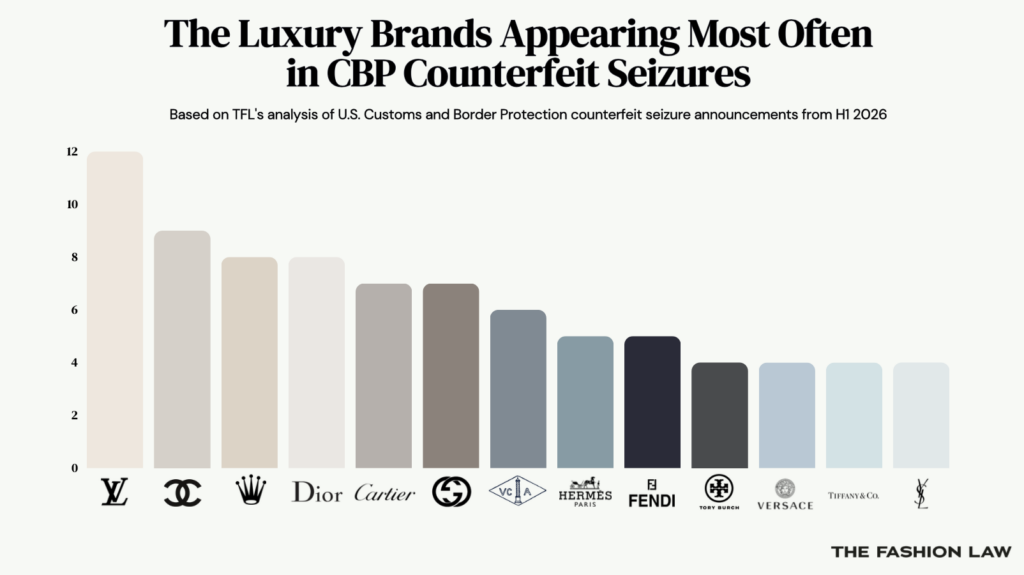
The seizure data appears to reflect that reality. Between January 1 and June 30, 2026, Louis Vuitton and Rolex were tied as the most frequently referenced brands in CBP fashion and luxury announcements reviewed by TFL, each appearing in 13 separate seizure reports. Chanel and Cartier followed with 10 mentions each, while Gucci appeared nine times and Dior eight. Van Cleef & Arpels and Hermès were each referenced six times. While the underlying products ranged from handbags and wallets to watches and jewelry, the same names surfaced repeatedly across ports of entry and product categories.
Recognizability as an Asset
The concentration is notable because the luxury market encompasses thousands of brands and countless products, yet enforcement activity repeatedly clusters around a relatively small group of iconic goods. The products at the center of CBP seizure announcements from the first half of 2026 were not obscure fashion items, but logo-bearing wallets, signature bracelets, established watch designs, and accessories featuring globally familiar motifs.
That pattern may reveal something broader about how luxury value operates. Historically, it has rested on craftsmanship, heritage, exclusivity, and distribution control. Those factors still matter, but the seizure data suggests that, from a counterfeiter’s perspective, the products most worth copying are often those that consumers across markets and demographic groups can identify almost instantly.
That reality creates a complicated and longstanding tension for luxury brands. The distinctive designs and branding elements that make their products commercially powerful also make them easier to identify, reproduce, and sell illicitly at scale.
THE BOTTOM LINE: Taken together, the CBP seizure data offers more than a simple snapshot of enforcement activity. The brands that appear most often are not simply among the industry’s biggest players. They – and their products – have become some of the luxury market’s most familiar cultural symbols, making the data an alternative way to assess brand visibility, consumer awareness, and, to a degree, brand equity. In short, counterfeit seizure data can serve as an unexpected measure of brand power.
Share