


The resale market is booming, fueled by sustainability narratives, price arbitrage, and platform scale. But as secondhand luxury continues to migrate from consignment racks to a global, digitized marketplace, the legal exposure facing resellers is intensifying. From The RealReal and Poshmark to Vinted and Vestiaire Collective to thousands of independent sellers on open platforms, resale has become a sophisticated commercial ecosystem. And with that evolution has come a sharper question: How far can resale companies and independent sellers push marketing, authentication, and brand signaling before they cross the line from a legal perspective?
At a high level, the resale of authentic goods is permissible in the United States and other key markets. However, in the luxury realm, where companies actively engineer scarcity, presentation, and post-sale control as part of the brand experience, the margin for error narrows quickly. Even modest deviations in how a product is packaged, described, or positioned can carry legal consequences.
Unauthorized But Legal – To a Point
Much of that risk flows from the structure of the secondary market itself: many resellers operate without any formal relationship with the brands whose goods they sell. They are not authorized distributors and do not hold licensed rights to use logos, campaign imagery, or brand assets beyond fair-use principles.
In the U.S., the first-sale doctrine generally permits the resale of genuine goods lawfully acquired. That protection erodes where goods differ in “material” ways – including the removal of serial numbers or UPCs, altered or incomplete packaging, warranties that no longer apply, or distribution outside brand quality-control protocols – and exposes sellers to trademark infringement, unfair competition, or false advertising claims even where the underlying goods are otherwise authentic.
In the European Union and United Kingdom, trademark exhaustion permits downstream resale once goods are placed on the market with the rights-holder’s consent, but only up to a point. Trademark owners may oppose further commercialization where “legitimate reasons” exist, most commonly where the condition of the goods has changed or where downstream presentation materially harms the mark’s functions. The net effect is similar: resale is permitted, but the conditions under which goods are marketed and sold can give rise to trademark and related causes of action.
When Marketing Becomes Infringement
Where luxury resale attracts some of the most significant legal scrutiny is in marketing, particularly how goods are described and how closely a reseller aligns itself with the underlying brand. Unauthorized sellers typically lack permission to use others’ logos, campaign imagery, ad copy, or brand visual systems beyond limited fair-use principles, which permit referential use of a trademark to identify the branded goods being offered, provided the use does not imply sponsorship. Yet many resale platforms lean heavily on brand-facing assets to drive traffic, confer legitimacy, and, in some cases, borrow the brand equity that generates demand in the first place – a strategy that can amplify consumer demand and invite litigation.
The potential for legal action accelerates when resellers go beyond pure identification and begin trading on brand identity. That includes using logos in site headers, mimicking official visual systems, or deploying affiliation language such as “authorized,” “certified,” or “approved.” Courts have treated these terms not as neutral descriptors, but as objective claims that, if untrue, can trigger liability under trademark and false advertising law.
And while disclaimers about source or lack of affiliation may mitigate consumer confusion in some circumstances, they are not a cure for an otherwise misleading overall commercial impression. If a platform’s presentation suggests brand involvement notwithstanding fine-print disclosures, the likelihood-of-confusion analysis tilts against the reseller – even when the goods at issue are authentic.
The Legal Stakes of “Authenticity”
Just as affiliation language can create exposure, the resale market’s own buzzwords also carry legal weight. Platforms routinely market inventory as “100% authentic,” “verified,” or “guaranteed genuine,” claims that operate as actionable advertising representations rather than mere puffery. And these claims have not gone without challenge.
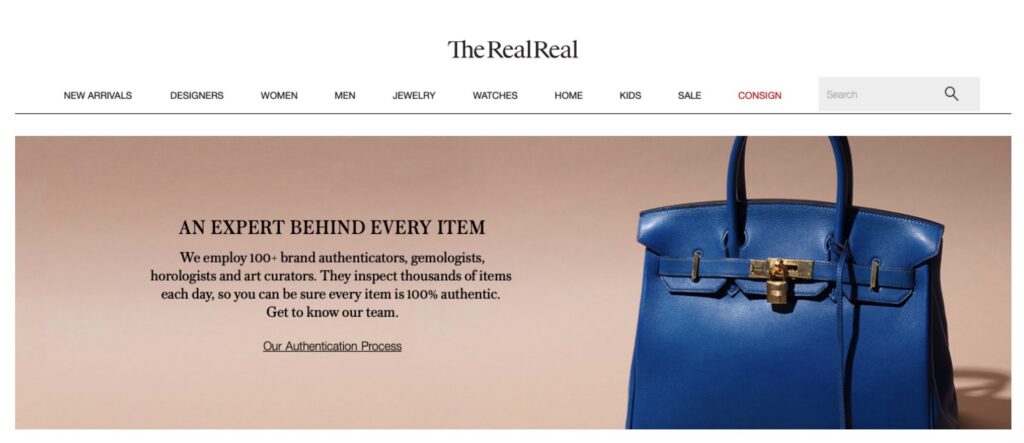
Chanel has alleged that What Goes Around Comes Around’s authentication guarantees implied a relationship or endorsement that did not exist and has similarly argued that The RealReal misled consumers by positioning authenticity as the foundation of its business while conveying a level of authority it did not possess. According to Chanel’s pleadings, consumers treat authenticity as a material condition of purchase.
Parallel pressure has surfaced in the sneaker and streetwear segment. StockX, for one, announced in 2022 that it had updated the name of its verification process, moving away from labeling products as “Verified Authentic” and “100% Authentic” in favor of its own “StockX Verified” designation. The change came about as StockX faced a since-settled trademark case waged against it by Nike, which took issue with StockX peddling products as “100% Verified Authentic.”
Read together, these developments reflect a broader recalibration: the language platforms use to manufacture trust is no longer merely a branding exercise, but a choice with legal consequences.
“New” Means More Than Just “Unused”
Descriptors such as “new,” “brand new,” or “never worn” carry legal consequences of their own. Consumers may read these claims primarily as signals of lack of use, but they often also imply factory condition, complete original packaging and accessories, and, where applicable, eligibility for manufacturer warranties. Where products are missing tags, have circulated outside controlled channels, or no longer carry brand warranties, labeling them “new” can mislead even if the item appears untouched, an issue that extends beyond trademark doctrine into state and federal consumer protection regimes.
The risk sharpens further where serial numbers, authenticity cards, or barcodes are removed or altered, undermining brand quality-control systems and potentially creating the “material differences” that defeat first-sale or exhaustion protections. In practice, disciplined condition language – “like new,” “open box,” “unused,” or “pre-owned,” paired with plain-language definitions – will likely preserve consumer trust while narrowing the chance of litigation.
THE BOTTOM LINE: Luxury resellers cannot rely on the first-sale doctrine as a blanket shield. Once products are altered, claims are overstated, or marketing implies brand affiliation, the legal footing weakens rapidly. For resale operators, compliance must be embedded in daily operations: Product descriptions must accurately reflect condition, packaging, and warranty status; brand imagery, logos, and marketing language should not be used without authorization; authentication claims must be substantiated and carefully framed; and disclosures must be conspicuous and meaningful.
Share